
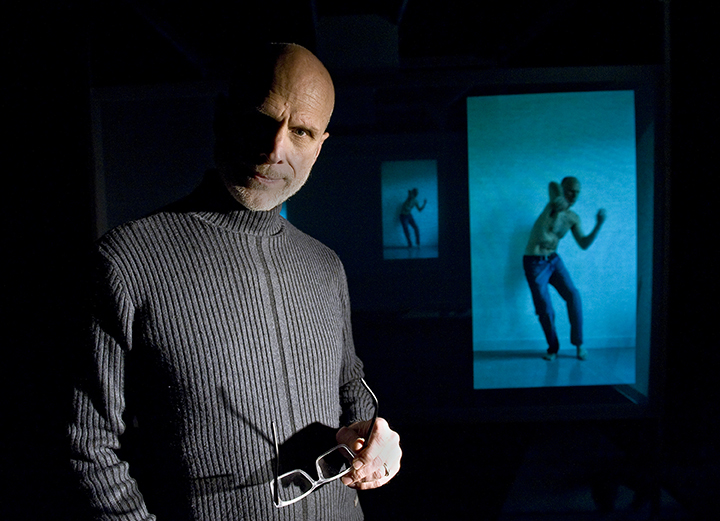
Using an array of high-tech software and hardware, U-M Professor Peter Sparling creates a 3-D dance experience that extends far beyond what’s possible on a traditional stage, and provides a new challenge for where and how such performances are archived.
by Lara Zielin
Among the cluster of similar-looking buildings that make up the University of Michigan’s North Campus Research Complex is one with a long escalator that takes you to the basement, and there you’ll find a small, non-descript room with black walls. Arranged horizontally in the space are three screens, each about seven feet apart, onto which three projectors display images of dancers in various states of motion.
Music plays—sometimes a caco-phony, sometimes a symphony. As the music swells, dancers hurtle themselves directly at the closest screen, while others leap away on the farthest screen. Some of the dancers’ bodies pass through others. A few dancers perform alone. Reflections ripple along the floor. If you want, you can walk between the screens, changing your viewpoint of the action, the sound, the placement of the movement in space and time.
Your tour guide in this space is Peter Sparling, the Rudolf Arnheim Distinguished University Professor of Dance and an Arthur Thurnau Professor of Dance in the School of Music, Theater & Dance at the University of Michigan. He’s tall and lean—a Juilliard-trained dancer in his own right—and he calls this whole experience the PUPP, short for Pop-Up Projectile Pavilion.
His goal is to get you to see these bodies, this motion, differently than you would if it were presented in 2-D. His hope is that your brain gets used to the bodies morphing, to the fragmented depth perception, to the layers upon layers of sound and dance, and that your mind adjusts the more you watch. You learn this as Sparling narrates the experience, explaining everything as it’s happening—essentially becoming part of the projectile pavilion himself. “This is a moving landscape where there’s no horizon,” he says to the small audience gathered one evening this past winter. “You determine how much space the dancers have.”
Admittedly, this may all sound a little strange. But whether or not Peter’s art sits comfortably in your wheelhouse, this installment of his work is just one in a long line of innovative projects that challenge everyday ideas of dance and bodies and space, as well as the boundaries of what can be stored in an archive—and how. The Bentley has collaborated with Sparling to collect nearly 45 years of his materials from photos to letters to VHS tapes to website links. But this latest project presents a tougher archival challenge since it’s so experiential. How do you archive something that’s in 3-D, where the creator is part of the presentation?
A Composer with a Physical Score
The question is one that Sparling is keen to answer. He’s been pairing technology and dance since he attended the Juilliard School’s Dance Division from 1969 to 1973. “My first experiences in learning dances were through film projected on rickety projectors onto studio walls,” he says.
By the time Sparling was writing and performing his own dances in the late 1970s and throughout the 1980s, “the video camera had become portable and affordable enough to use to capture my rehearsals and performances.”

Sparling edits video in the Pop-Up Projectile Pavilion in U-M’s North Campus Research Complex.
Just as a composer weaves different lines of music into a single score, Sparling says that an installment like PUPP allows him to do the same thing with bodies. “The three screens allow me to play with visuals like a composer plays with lines of sound.” PUPP also works as a teaching device for Sparling’s students across campus, including those in the Department of Screen Arts and Cultures, the School of Art and Design, and those in dance composition classes.
“Students have an aha moment,” Sparling says, “where they have to reevaluate what depth is on a screen and how important it is to distinguish figures simultaneously but not all on the same plane.” It’s an especially important point for a generation of students who have grown up looking at iPhones and screens. “I like to mess with the ubiquitous homogenization of the screen,” he says. “Seeing two things at the same time prompts pedagogicalquestions such as, ‘How do we perceive depth?’ and ‘How can one achieve a tonality of visual material?’”
But there’s also a more practical side of this, related to what Sparling calls “the relatively short life span of the dancing body as a creative generator.”
In other words, Sparling is aging—he’s 63 now—and his body can’t sustain the same level of dance performance that it once could. Technology, Sparling says, “allows defined, brief sessions of dance,” which he can then manipulate at a computer. He’s still creating a performance and still creating art—it’s just through a different and more sustainable mode of production.
It’s a mode that’s also unquestionably sophisticated. Sparling uses video editing software to create a single composite file with different layers, which he then separates into three different Quicktime files and loads onto his three specialized projectors. Each Quicktime file can be manipulated so that the screens contrast duration and speed as well as depth and movement. “It’s a way to manipulate both time and space,” he says.
Finding the Director’s Cut
As technology evolves, so must archives—and this is a point on which Sparling has collaborated closely with the Bentley beginning in 2001. “Digital recording preserves, seals, and distills a lifetime’s work,” Sparling says. So while the Bentley may already hold many of his photos, letters, and even a webpage or two, archiving this complex video production means thinking more expansively about what an archive is—and what it does.
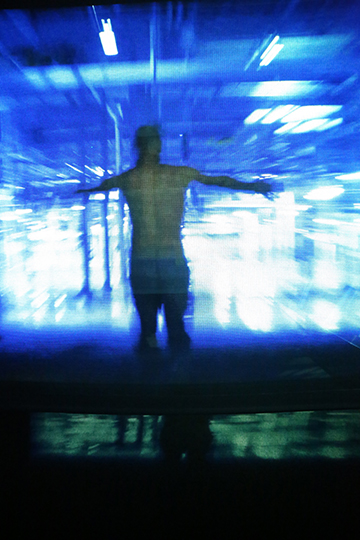
A video still from “Last Man at Willow Run,” which was shot in the Willow Run plant just months before its demolition.
“Archivists try to mirror both the creative process and the outcome, meaning an archive tries to give its users a director’s cut of the content,” says Nancy Bartlett, the associate director for academic programs and collections development at the Bentley Historical Library. “We’ll never have the perfect solution because it won’t be the in-the-moment performance of Peter Sparling. But it will be something else—the accumulation of his work over time and a way to access him that otherwise wouldn’t exist. Ultimately, the process is a compromise of sorts, which is fine as long as we’re being transparent about what we’re doing and inviting people to partner with it.”
In this case, Bartlett pictures the Bentley recording video of Sparling’s screens, “ideally with Peter’s voiceover to narrate and walk people through. It’s choreography that can be experienced in more than one way.” The file would then be stored in the Bentley’s digital archives and housed in Deep Blue, which preserves the best scholarly and artistic work at the University of Michigan.
The added bonus to the process is Sparling himself, according to Bartlett. “He’s the archivist’s friend because he’s explicit about his process and he’s very interested in it.”
Sparling might put it another way.
“My selfish endeavor to preserve a legacy has a ripple effect,” he says. “It supports an upgrading and updating of a library’s holdings to be more in step with a rapidly expanding global digital culture, and it participates in a discourse of the body.”
No matter the motive, the archive will preserve the fascinating life of a Michigan artist who grew up in Detroit and was a musician and a poet before he became a dancer. Many of the short films he shows on his three screens depict Michigan scenes such as the abandoned Willow Run plant, U-M’s empty ROTC building, or a secluded cabin outside of Petoskey.
He can still remember the moment when, as a teenager, he was lying in a field in northern Michigan, watching the stars and realizing, for the first time, that the constellations were stars in 3-D. “The immense pleasure that comes from that moment is very important,” he says. “After all, art is all about pleasure.”
Moving forward, Sparling’s vision is to recreate this 3-D experience in art museums, galleries, dance festivals, conferences, and more. “I’d love to get the PUPP into other locations on campus and off,” he says.
Myriad aspects of Peter Sparling’s body of work are accessible on-site at the Bentley Historical Library and online through Deep Blue, a repository of scholarly and artistic work at the University of Michigan.