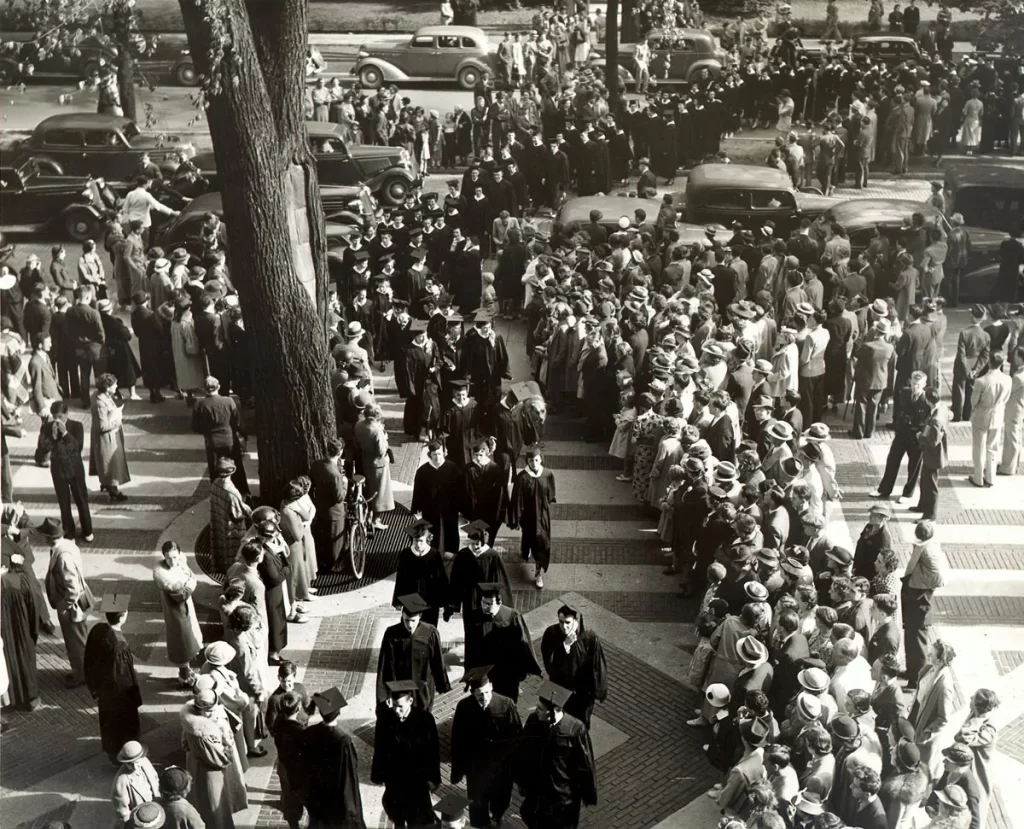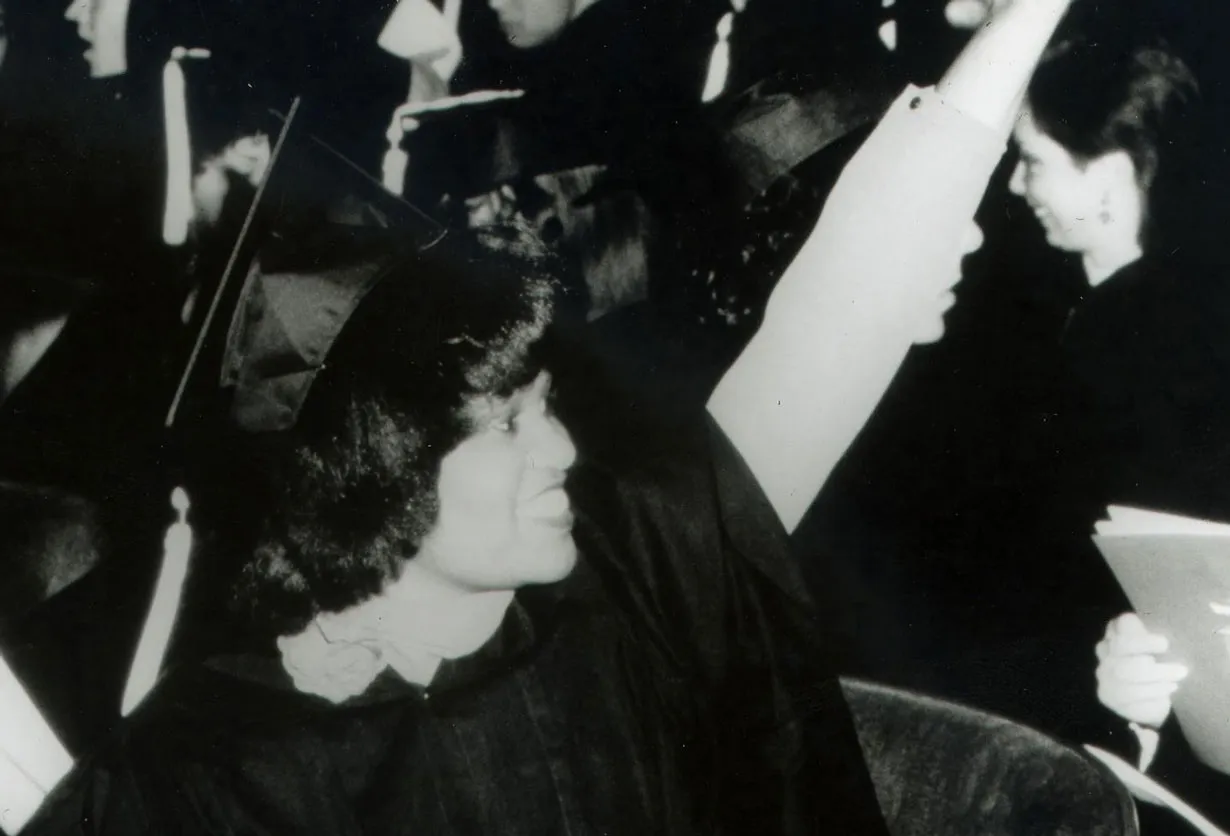
Every year, the thousands of students who graduate from U-M’s Horace H. Rackham School of Graduate Studies complete research projects ranging from complex lab work to groundbreaking field studies to painstaking examinations of archives—and countless more. It’s this work that helps make U-M one of the world’s leading research universities today. This year, the Rackham Graduate School celebrates its 150th anniversary.
But graduate education at Michigan—and in the United States more broadly—didn’t always look like this. Records preserved at the Bentley Historical Library reveal not only the evolution of graduate education at U-M, but also the stories of the men and women who earned their advanced degrees in Ann Arbor.
Today, a master’s degree and a doctoral degree represent different levels of academic achievement, but when they first emerged in the universities of medieval Europe they were broadly equivalent. The title magister (Latin for “master”) was given to university graduates when they began to teach, but the use of “master” or “doctor” in the degree name was generally a matter of custom at a university. By the early 1800s, however, the master’s had become a distinct degree, typically awarded to former students who demonstrated some sort of vaguely academic merit since their graduation. This was known as earning a degree “in course.”
Just as every other college and university in the United States in that period, it was this type of master’s degree that U-M first granted. In April 1845, the university’s Board of Regents voted that no candidate for a Master of Arts “shall receive this honor, unless he has preserved a good moral character, and…has signified his desire [for such a degree] to the Faculty.” Four years later, the Regents awarded the first two masters’ degrees to Merchant Goodrich (B.A. 1845) and Winfield Smith (B.A. 1846).
According to Bentley records, Goodrich was a member of the first U-M class in Ann Arbor after it had moved there from Detroit and went on to be the first U-M alum to attend Harvard Law School. Smith would go on to serve as Wisconsin’s Attorney General, but he never learned of the honor he’d received from his alma mater. As he lamented in 1889, he had “applied for [his master’s], wrote Latin essay, & sent on, but never heard anything from it, suppose the essay was not good enough.” Clearly it was more than good enough, but U-M’s non-existent alumni communications team was lacking in those days.