
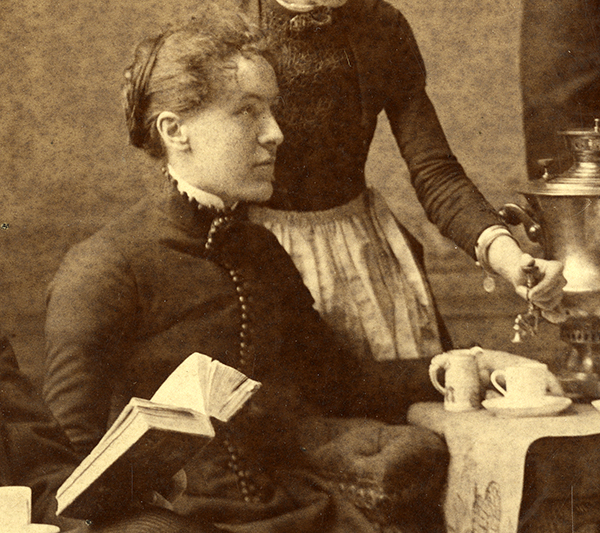
Alice Chipman Dewey was a philosopher, social reformer, educator, pioneer, and among the earliest women to graduate from U-M. Her incredible legacy has been historically overshadowed by that of her husband, John Dewey, though research and papers at the Bentley are now helping define Alice in her own right.
By Sarah J. Robbins
Of the little that is well-known about the rich life of Alice Chipman Dewey—one of the first women to graduate from the University of Michigan, a founder and a freethinker and a philosopher, who dedicated her life to education reform—almost all is connected to her husband, John Dewey. The two shared the same boarding house in Ann Arbor, on the northwest corner of Maynard and Jefferson Streets. It is here where Chipman, a philosophy major, first got to know the shy new instructor in the Department of Philosophy, when they both were in their mid-20s, more than 135 years ago.
Of John Dewey, much is known: He is widely considered to be a leading American philosopher, a proponent of pragmatism, and a pioneer of social reform and progressive education. Of his partner of 41 years, “no biography of her has ever been written, and she has been virtually neglected in the historical literature on progressive education,” wrote Irene Hall in her 2005 thesis The Unsung Partner: The Educational Work and Philosophy of Alice Chipman Dewey. “She is mentioned in biographies of her husband, but these biographies provide little insight into her thinking or her life.”
As U-M prepares to mark the 150th anniversary of women’s admittance in 2020, there is still so much to understand about profound ways that women have shaped the university and the world. And nowhere is that power more apparent than in the story of Chipman Dewey, who guided her husband’s focus from the purely theoretical to the more practical. She was an equal partner in many ways—particularly in his quest for education reform. And materials at the Bentley Historical Library help paint a richer and more detailed picture of her life and work.
Common Ground
Harriet Alice Chipman was born in 1858 in Fenton, Michigan. She and her sister, Augusta, were raised by their freethinking maternal grandparents when both of their parents died before she was five years old. Her grandfather was originally a fur trader from Upstate New York, who championed the rights of women and American Indians.
Chipman had wanted to attend the University of Michigan immediately upon her graduation from high school, but she instead stayed closer to home to care for her grandmother. She studied music briefly, and then saved money for tuition while working as a high school teacher in nearby Flushing. Though she matriculated later than she would have liked, she was still among the first women attending classes at U-M and therefore in the country. That’s because U-M’s president, James B. Angell, held a much more progressive attitude about educating women than most other higher education leaders at the time. But even at her forward-thinking university, only 10 percent of her classmates were women.
In those days, the trees on the Diag had just been planted, and dormitories didn’t exist. “The students were taught self-reliance by being thrown together in board – ing houses—just as they are forced to live when they leave college,” wrote U-M student Genevieve O’Neill in response to a 1924 survey of all of U-M’s female graduates conducted by the University of Michigan Alumnae Council, and known more commonly today as the Alumnae Survey. “The intermingling of boys and girls in the same home brought about a democratic and broadminded outlook upon life, as well as mutual understanding between the sexes.”
Chipman and her classmates struggled for equal access. Still, six out of 13 philosophy majors in her graduating class were female. Chipman had already taken several classes in the department when Dewey arrived as an instructor, earning a $900 annual salary. She eventually took three of his classes: Plato’s Republic, Special Topics in Psychology, and Greek Science and Philosophy.
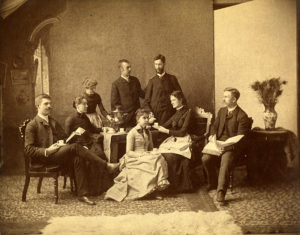
Alice Chipman Dewey was a member of the Samovar Club, which met to discuss literature and philosophy and drink hot chocolate. Members in this photo are: (Back row, standing left to right) Elise Jones, Charles H. Cooley, Allen Pond. (Seated left to right) Will McAndrew, Alice Chipman, Caroline Gelston, Mary Ashley, Delbert J. Haff.
As they became more closely acquainted, Dewey was working on his first book, Psychology, as well as two early articles—one that analyzed the method of social science, and the other that looked at the effect of a university education on women’s health. The latter seemed a departure for the philosopher, wrote Linda Robinson Walker in her 1997 Michigan Today article, “John Dewey at Michigan”: “It suggests that by 1885 he was a feminist and one of the reasons may have been the influence of Alice Chipman.”
At Michigan, Chipman helped establish the first-ever college chapter of the women’s club Sorosis, which was founded in 1868 in New York City, and included the writer George Eliot, the abolitionist and women’s suffragist Lucretia Mott, and many other powerful women of the day. Along with Dewey, she was also a founding member of a Russian literature club called the Samovar. In the words of the Argonaut, the student-run paper before The Michigan Daily, the club took its name “from the Russian tea pot around which the members will gather on the snug winter evenings of the coming season.”
Chipman was particularly interested in Tolstoy’s accounts of establishing his own free school for peasant children and his analysis of public education. These tea-time talks, and the time they spent together around them, reflected big questions about social progress at a time of widespread industrialization and urbanization.
Home as School, School as Laboratory
Dewey was promoted to assistant professor in 1886, with a huge salary increase—to $1,600. In preparation for her graduation that year, Chipman sat on the com – mittee that sent out invitations to the senior reception. She did not, however, consent to adding her height, weight, and hair and eye color to be catalogued in the yearbook, then called the Castalian. The couple married a month later, in Chipman’s hometown.
Though Chipman Dewey continued her association with Sorosis and helped found the University’s Women’s League in 1890, her focus turned inward. Decades later, she would respond to her own 1924 Alumnae Survey survey and list her career as “homemaker.” She saw and seized true power in that role—first as an active faculty wife, hosting receptions in a home that, according to the wife of one of Dewey’s colleagues, was “a meeting place for the best minds in Ann Arbor.”
The couple would have seven children; the first, Fred, was born in July 1887, and two more would follow in Ann Arbor. The couple’s letters from this time reveal hands-on, self-reflective parents who believed in the value of discovery and independence. In one letter, Chipman Dewey wrote that children “show the value of their bringing up in the way they look after themselves.”
Some of this freedom did raise the ire of the neighbors. One dissertation on Dewey, written by Willinda Savage, includes the remembrance of a fellow professor’s wife, who said that some parents “had to convince their own children that they couldn’t ignore shoes and stockings as the Dewey children did.” The Deweys seemed to care little for appearances, working to find, follow, and foster their children’s interests. These efforts ranged from supplying cameras, tools, and stamps for collecting, or inviting Fred and his sister Evelyn to witness the home birth of their younger brother, Morris.
The Deweys’ study of their children was driven both by love and academic interest. In The Psychology of Infant Language, published in 1894, Dewey charted the behavior of Fred and Evelyn over the course of 19 months, concluding that having other children in the family helps the speed and range of vocabulary development.
This focus on language—including foreign language—was a priority, and the children benefited from immersion: In 1894, Chipman Dewey and the children spent several months in Europe, sending letters home that detailed time with French teachers, trips to Versailles, and many books. Two-year-old Morris contracted diphtheria on this trip and died while the family was overseas.
This tragedy marked the close of the family’s time in Michigan. John Dewey had accepted a new position at the University of Chicago, where he would oversee a new department that combined philosophy, psychology, and education.
Practicing Theory
The Deweys’ circle in Chicago included many of the other progressive leaders of the day, including Jane Addams, co-founder of Hull House, one of the nation’s first social settlements (John Dewey was a trustee for several years). Chipman Dewey and Addams were very close, according to Hall, who says that they shared beliefs about education and social action. One of the Dewey girls, Jane Mary, was named after Addams and her lover, Mary Smith.
To further both their work and their children’s educations, the couple together founded the University Elementary School, widely known as the “Laboratory School,” in 1896. Unlike many schools of its kind, which prioritized teacher training, it instead focused on investigating ideas and methods. Chipman Dewey directed the school’s English program; she also served as principal from 1900 to 1904, growing the original 16 students to a group of 140, who ranged in age from four to 16.
Among the ideas that guided Chipman Dewey’s work at the school was her belief in the important connection between school and home. Cooking was a key part of the curriculum, for example, incorporating math, science, art, and social interaction. She expected a great deal of her teachers, writing that their job was “to give the child a fair opportunity to reveal himself.”
Neither Chipman Dewey’s standards nor her methodology suited everyone. There was friction between the Deweys and the president of the University of Chicago, William Rainey Harper, both over the school itself and his broader views of education, including his belief that men and women should be taught in separate classes. In 1904, Harper consolidated the Laboratory School with another campus school, causing an abrupt end to Chipman Dewey’s tenure. Her husband resigned the next day in protest, later accepting a role at Columbia University.
Before Chipman Dewey and the children settled in New York, they embarked on another sea voyage to Europe, on which Gordon contracted typhoid fever. He died soon after. (The Deweys later adopted Sabino, a child they met in Venice, completing their family.)
While in New York, Chipman Dewey continued to write and to teach, developing coursework for correspondence courses through the School of Liberal Arts and Sciences for Non-Residents. Chipman Dewey’s focus was elementary education; she wrote in the introduction to one methods class that “all teaching should follow an order that is to some extent new, that has some degree of variability in its progress.”
The years to follow brought much writing, travel, and activism—particularly for the cause of women’s suffrage. Chipman Dewey was the vice president of the College Equal Suffrage League of New York City—a part of the National American Woman Suffrage Association—which, according to Hall, focused on the idea that education was a tool to bring about social change. She later served as Assembly District leader for the Woman Suffrage Party of New York City, sparking controversy in 1911 for inviting both white and black women to her home for a recruitment drive.
The slow progress toward suffrage disturbed Chipman Dewey. Writing to her daughter, Lucy, she asked, “This is still a world of sad revelation for what men do and do not think about women, is it not?”
Her study of women’s rights took on an international focus in later years, particularly in 1919, when the couple went on an extensive speaking tour of Southeast Asia, also spending several months in Japan and then time in China. During a later trip to Mexico, in 1926, Chipman Dewey suffered a heart attack, followed by a series of other ailments from which she never recovered. She died in 1927, just before her 70th birthday.
Despite an outpouring of remembrances after her death, Chipman Dewey’s influence seemed to quickly fade from view. In John Dewey’s obituary in The New York Times, 25 years after his wife’s death, she is mentioned briefly and in name only—a pattern that has been followed by many biographers since.
These omissions distressed her children, writes Hall, who sought to rectify this in her own course of study. Without “understanding Alice Dewey’s crucial work as an innovative educator and social activist,” she argues, biographies of John Dewey and histories of 20th century education are incomplete.
There is not an Alice Chipman Dewey collection at the Bentley Historical Library, though the collection of her husband, John Dewey, is open to the public.
Additional sources for this story include:
Jim Tobin, “The First Women,” Heritage.umich.edu; Linda Robinson Walker, “John Dewey at Michigan,” Michigan Today, Summer 1997; Irene Hall, The Unsung Partner: The Educational Work and Philosophy of Alice Chipman Dewey, Harvard thesis, 2005; The 1924 University of Michigan Alumnae Council Survey (Alumnae Survey).