
The hard truth about an Ann Arbor landmark
By Louis Miller and Lara Zielin
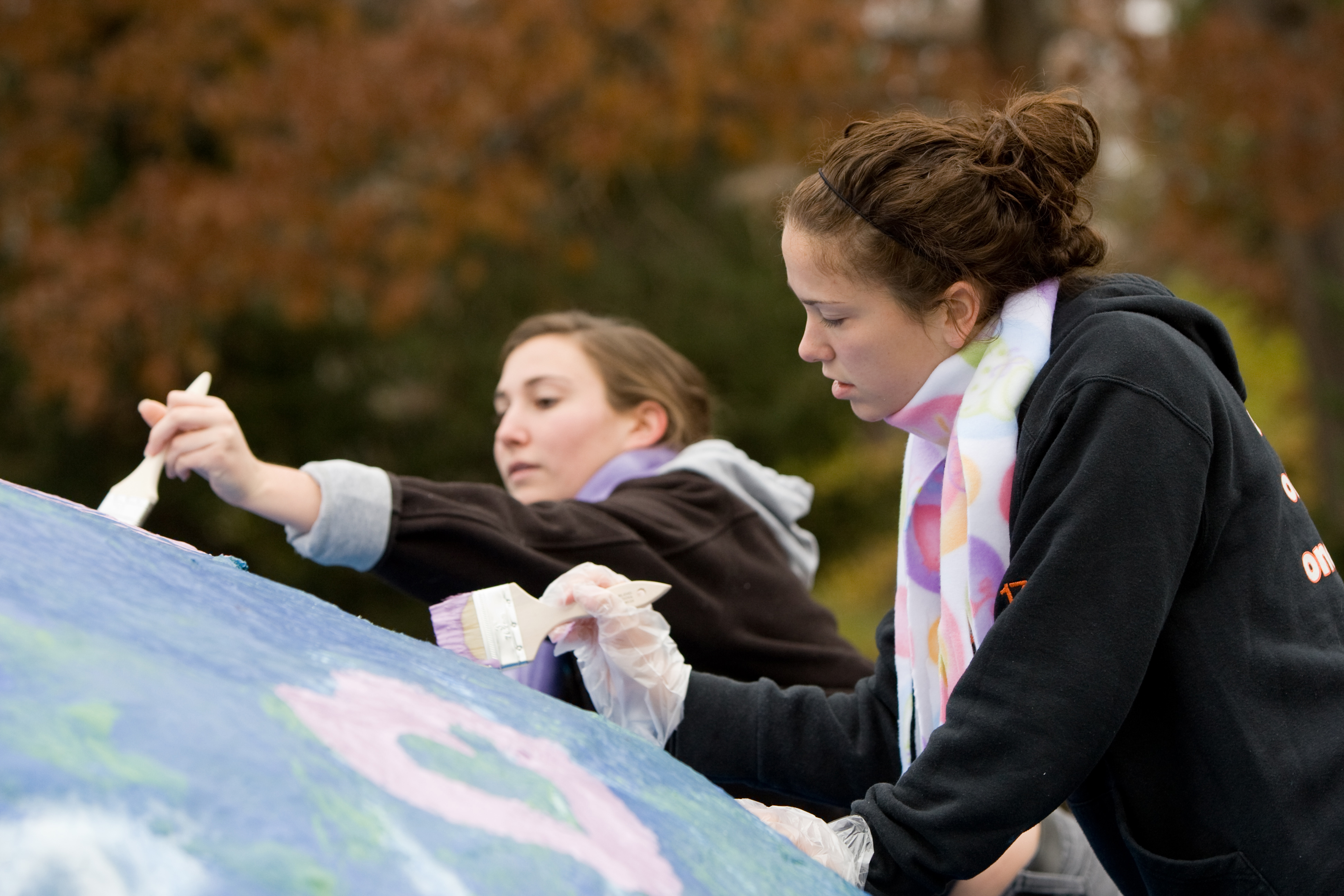
Chances are, you’ve seen it. The garishly painted boulder at the corner of Washtenaw Avenue and Hill Street in Ann Arbor, resting on a tiny triangular piece of city-owned land, is hard to miss.
But you may not know the rock’s origins—nor its commemorative role to honor a U.S. president.
Mention of the iconic rock first appears in an Ann Arbor News story from December 1932 with the headline: “Bowlder [sic] Placed in City Park.” Eli Gallup was the driving force behind the mammoth stone’s new locale. An Ann Arbor’s parks superintendent for nearly half a century (1919-1964), Gallup was also “quite a rock collector,” according to an Ann Arbor News story dated November 5, 1972. The News says that he spotted the chunk of glacial limestone “in the county gravel pit on Pontiac Trail” and wanted to use it to memorialize George Washington, whose 200th birthday was February 22, 1932.

The George Washington Memorial (circa 1932) includes a memorial plaque that was salvaged from scrap metal during the Great Depression.
The boulder was rolled into place in the winter of 1932 with help from a heavy-duty Detroit Edison truck, according to an Ann Arbor Observer article from March 5, 2009. In the foundation under the memorial, Gallup buried a time capsule that included its written history. Because copper was scarce at the time, Gallup had to secure enough of it—including scouring Dumpsters for scraps—before he could commission a memorial plaque. Seven years after the rock’s installation, a shield-shaped insignia was mounted onto the stone, facing Washtenaw Avenue. It read: “To George Washington this memorial erected in celebration of the two hundredth anniversary of his birth, 1932.”
It’s not precisely clear when people began to paint the memorial, but it was likely sometime in the mid-1950s. The first alleged incident, according to the 2009 Observer article, was after a Michigan versus Michigan State football game, when someone reportedly painted the letters M.S.U. on the memorial.
A sign erected next to the rock in the early 1970s begged people not to paint the memorial, but it went unheeded. Once started, the tradition of painting the rock couldn’t be undone, and it continues today.