
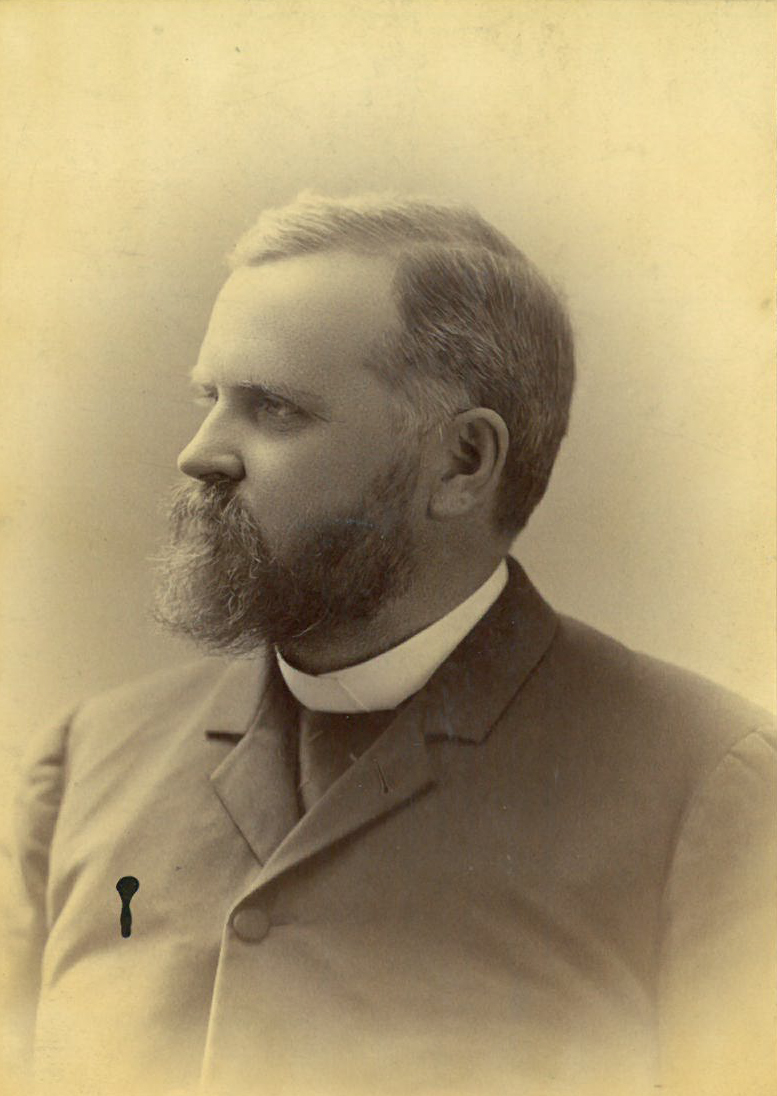
Before much was understood about mental illness, before calls for compassionate treatment were raised, before a genius in the throes of a disorder could get help, there was Mark Walrod Harrington, a U-M professor and third director of the Detroit Observatory. His descent into madness would take him around the world, before landing him in an East Coast hospital where he could always name constellations, but never himself.
by Fritz Swanson
In 1901, logs covered the water in great dense rafts, all flowing down toward Port Blakely, Washington. One particular worker, wearing his spiked boots and holding his long hook, could make it across the logs with careful ease. He could roll the logs, he could run over them lightly, and, with his keen eye, he could tell moments before a jam would form, and pull the logs straight so that they could flow safely to the mill.
He had seen men pulled under in the flow, the logs parting and then closing, the bodies never found. But that never happened to him. He was focused and attentive.
The only problem was that most of the days he couldn’t remember who he was.
When he would come home in the evening to the dirt-floored cabin built with great fir logs, he would take down a copy of Pliny’s Natural History and effortlessly read the Latin.
After a time, he would close the book and see that in the front was written his name: Mark Walrod Harrington. Some days, he might remember his name all day long.
From his little window he would take note of the position of the stars, and he might also say their names aloud. He could, from his cabin on Bainbridge Island by the lumber mill, see across the narrow water to the lights of the young city of Seattle on the other side. Perhaps he might recall that he used to live over there in the city when he was president of the University of Washington in Seattle.
Cry Havoc
Mark Walrod Harrington was a botanist, astronomer, meteor-ologist, field entomologist, and a geologist. He knew a half- dozen languages. He was director of the University of Michigan’s Detroit Observatory, the first civilian head of the U.S. Weather Bureau, a State Department liaison in China, and president of the University of Washington in Seattle.
And then he was a lunatic.
And Let Slip the Dogs of War
Harrington was born in Illinois in 1848. He attended the University of Michigan from 1865 to 1871, earning his bachelor’s degree and then his master’s. Before he was even finished with his undergraduate work, he became a teaching assistant to Alexander Winchell, chair of the Department of Geology, Zoology, and Botany. As he began his master’s work, he was teaching a biology class (at the request of President Haven) and acting as entomologist on a University expedition to the northern shore of Lake Superior.
In the early 1870s, he turned down a Regental appointment as a mathematics and French instructor to go with the Coast Guard to the Aleutian Islands, where he was the expedition’s astronomer. For the next two years, Harrington sent U-M more than 1,000 botanical and geological specimens representing about 300 different species from California to Alaska.
Harrington returned to U-M in 1873 as an assistant professor of botany. In 1874, he married Rose Martha Smith, a woman from his hometown in Illinois. They quickly had a boy together but, in 1876, their young son died. Harrington had planned a year’s sabbatical alone in Germany, but given the loss, he and his wife both went abroad. While in Europe he and Rose learned German, lived simply, and mourned.
Finally, he turned his attention back to botany, traveling to Kew Gardens in England. There he wrote the very first botanical paper identified with the University of Michigan, and on the strength of this publication, Harrington was elected Fellow of the Linnean Society of London. He was the first Michigan scholar elected to serve in a society that included Darwin among its members.
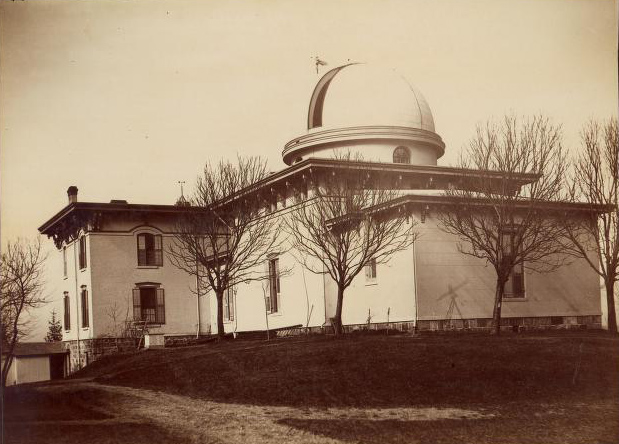
The Detroit Observatory in 1888, when Harrington would have been its director. (Bentley image BL001683)
In 1877, Harrington left U-M to join the State Department, which had hired him as a professor of astronomy at its Cadet School in Peking, China. He produced and published a translation of the Official Chinese Almanac for the American Journal of Science in 1878, but shortly thereafter, the State Department forced him home for reasons of “ill health.”
Kenneth Lester Jones, a U-M professor of botany, describes Harrington’s career in a pamphlet for The Michigan Academician held in the Bentley Historical Library. Jones draws heavily on letters between Harrington and many of his friends at the University of Michigan, as well as the numerous books and articles Harrington wrote over his career.
Jones notes this may have been a pivotal mental health moment in Harrington’s life, based on letters at the time. At least two, including one to U-M asking for his job back, were written in “an unusual broad hand” in contrast to his normally “close, tidy hand.” In his letter to U-M, he includes a brief C.V., but forgets to mention that he ever earned a master’s degree.
President Angell had also served in China as a diplomat and seemed very happy to bring Harrington back. His old professorial job was filled so, instead, Angell appointed Harrington to be the director of the Detroit Observatory in 1879.
In 1882, the Harringtons had a second son, Mark Raymond. The boy, like his father, had a capacious curiosity. Harrington spent his days at the Observatory and his evenings and weekends with his son scouring the hills of the Ann Arbor countryside for plants and rocks and arrowheads.
Harrington worked conscientiously as the new director of the Observatory, doing substantive work observing the asteroid Vesta, as well as the trifid nebula in the Hercules constellation.
Yet his real innovation was equipping the Observatory with meteorological instruments, turning it into a weather station. As part of this work he founded, and served as editor of, the American Meteorological Journal.
He was director of the Observatory for 12 peaceful and largely uneventful years.
He is a Dreamer; Let us Leave Him
In 1891, he was appointed the first civilian chief of the U. S. Weather Bureau and relocated with his family to Washington, D.C. He published extensively on issues of the weather, setting the groundwork for the public consumption of technical weather information. He also worked on his book About the Weather, an introduction to meteorology for the layman.
But in 1895, he was fired from the bureau by Grover Cleveland. It seems the bureau, which was composed of many military men from its days as the Army Signal Corps, could not tolerate Harrington’s erratic management style.
In 1896, he became president of the University of Washington.
By the spring of the next year, he had resigned. A special committee was established to report on his one-year term, and wrote this about his resignation:
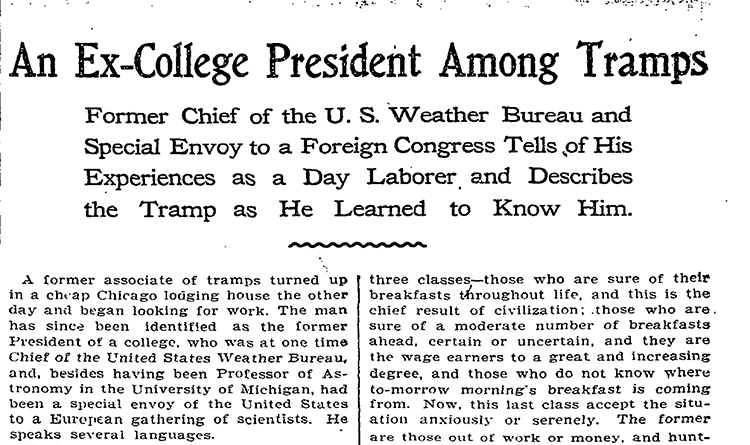
A June 1902 headline about Harrington appeared in The New York Times.
“[W]e are constrained to recommend that his resignation be accepted…particularly in view of the fact that…he has neglected his duties, left them to be performed by others, and proved himself incompetent to fill the office of President of the University.”
In the fall of 1898, Harrington was a section director for the Weather Bureau in Puerto Rico, but again “health” drove him from the work. In the summer of 1899, he retired to his home in Mount Vernon, New York, with his wife and their now 17-year-old son. That same year, About the Weather finally came into print.
Later that same summer, he told his wife that he had a dinner appointment. He stepped out the door and was gone.
The Ides of March are Come
For the next 10 years, Rose and her son knew nothing of Harrington’s whereabouts.
It wasn’t until 1908, when Mark Raymond was out west collecting Native American artifacts, that he read a report in a local newspaper about a strange new admission to the Morris Plains Asylum for the Insane. He contacted his mother immediately, and she discovered that the man, admitted as John Doe the 8th, was in fact her husband. In 1909, the Detroit Free Press described Harrington’s situation this way:
Former Michigan Man in New Jersey Madhouse Recognizes All the Stars, but Can’t Recall His Own Name
This was not the first newspaper to report on Harrington over the years. In 1901, the St. Louis Post Dispatch reported on Harrington’s time logging in the Pacific Northwest. In June 1902, The New York Times wrote about Harrington in a Chicago flophouse: “An Ex-College President Among the Tramps.” In the article, Harrington describes his time jumping boxcars with other men as they journeyed from Georgia to Louisiana.
And then, in 1907, Harrington came to the Morris Plains Asylum without any memory whatsoever. He could still converse in several languages, and read Latin as easily as English. This caught the attention of yet another journalist whose article ultimately ended up in the hands of Harrington’s son.
Rose came as soon as she heard, and confirmed his identity on sight. He refused his name, however, insisting she call him John Doe. He would allow the nurses and doctors to call him Harrington, but never Rose.
According to the Detroit Free Press, after leaving his wife and son that night in New York in 1899, the next few years were a tapestry of journeys and sickness: Harrington traveled back to China, where he tutored students in English, became ill, and then saved up enough money to sail back home. He landed in the American South after passing through the Panama Canal. He worked on sugar plantations, then traveled west to stake a claim, and to work as a lumberman. From there he returned to the Chicago flophouse, and ultimately on to New Jersey, where his memory finally and completely failed. Alone and afraid in Newark, he came to a local police precinct seeking shelter from the rain.
The specifics of his global perambulations are unknowable. The cause of his madness, likewise, is unknown.
As far as Rose was concerned, however, the cause was specific. According to the University of Washington in Seattle, Rose claimed that Mark, while investigating clouds over campus during his brief tenure there, was struck by lightning.
Mark Walrod Harrington died at the Morris Plains Asylum on September 10, 1926.