

Harvey Ovshinsky like to joke that it took him four years to write his book. “Two years to write a bad book, and two years to write a good one,” he says.
But when he completed his memoir, Scratching the Surface: Adventures in Storytelling (WSU Press, 2021), he says he had an out-of-body experience as he floated above his latest work and his life. He reflected on the many hats he has worn: underground newspaper publisher, writer, radio news director, documentary filmmaker, teacher.
“By God,” Ovshinsky thought to himself, “it’s a lot of dots I connected.” And he says chronicling his life’s work and imparting lessons in his book might not have happened if not for the Bentley Historical Library. At the very least, it would have likely taken more than four years.
“The Bentley was essential to the development of the book,” Ovshinsky says.
Why Not Me?
The library and Ovshinsky came together soon after his father—famed engineer, scientist, and inventor Stanford Ovshinsky—died in 2012. Ovshinsky worked with the Bentley on donating his father’s papers, and asked if the library would be interested in his as well.
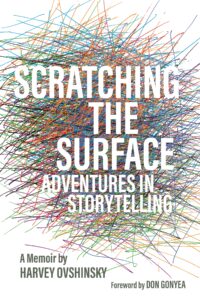
Ovshinsky’s memoir, Scratching the Surface, was released in March 2021. Image courtesy of Painted Turtle Press.
“I’m not my father, but I had a life,” says Ovshinsky, a Peabody- and Emmy-award winning documentarian who founded the long-running underground Detroit newspaper The Fifth Estate.
Bentley staff reviewed Ovshinsky’s work and decided his papers would be a nice addition to the archives.
“My personality is type A,” he says. “I gave them everything they needed and more—and I organized it.”
In addition to noting the print and digital materials in each box, Ovshinsky wrote detailed backstories sprinkled with the occasional “fun fact” on the contents of each. Such as the time his elementary school music teacher asked him to not sing so loudly, spurring his lifelong passion of finding his voice and helping others do the same. Or the junior high journalism teacher he had a crush on, who first introduced him to radio.
And the “life lessons” he imparts as part of Box 13, which includes his unproduced or unpublished projects.
“Just because a story or a project is never produced doesn’t necessarily mean it didn’t matter or wasn’t important,” Ovshinsky writes.
The Bentley as a Beacon
This exhaustive accounting was the “north star” that guided his writing. Without the Bentley accepting his papers and without him then putting together this comprehensive inventory, writing his memoir would have been more difficult, he says.
“It made it much easier to make it into a narrative that worked not only as a historical document, but also as a book,” Ovshinsky says. “I really wanted it to resonate for other people who shared my interest in creativity, in storytelling, and in truth telling. And I think I accomplished that.”
Others agree.
National Public Radio journalist Don Gonyea, who worked with Ovshinsky in Detroit before being moved to a national politics beat in Washington, wrote the book’s foreword. He praises Ovshinsky for being an “able and worthy guide” as he “searches for answers within himself—extracting the same kind of honest, human observations that he has long worked to coax out of others.”
Answering the Tough Questions
During the four-year research and writing process, Ovshinsky—who lives in Ann Arbor, not far from the Bentley—visited his collection at least a dozen times.
“The book is very detailed—a lot of quotations and recreations of dialogue and dates and a lot of stuff that I didn’t have off the top of my head. But the Bentley had my memory—it had my letters and my father’s letters.”
Ovshinsky says a goal of the book was to find out what his life’s work was really about. He said he could have gone the easy route and published a straight memoir, “a selfie—me, me, me,” he says. Instead, he treated himself like one of his documentary subjects, “a character named Harvey.”
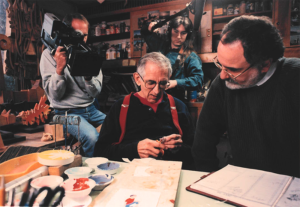
Ovshinsky and crew with an interview subject in an undated photo from his Bentley collection.
“I know what the questions are,” he says. “My challenge has always been to come up with the answers. I spent my entire life in print, on radio, on television, asking other people questions. Essentially spinning my yarn with their threads, telling my story with their answers.
“Well, the shoe’s on the other foot,” he says. “I have to tell my story with my questions and—guess what, Harvey—you’ve got to answer those questions.
“I want [readers] to learn what I learned the hard way,” he says, “on how to pull off this life of creativity, of how to endure, how to persevere, how to survive, and how to thrive.”
Ovshinsky hopes to share the book far and wide to college and high school students to impart the lessons he did over a lifetime of storytelling.
Climbing Higher
As a young boy, Ovshinsky’s father, a physicist, would take him to Detroit Metropolitan Airport to watch the airplanes take off. He’d tell his young son the hardest part of flying was the takeoff, the lift, because of the energy required. It required more energy to take off, the scientist told his son, than it did to fly the airplane.
Ovshinsky says he didn’t understand then what his father was telling him. But now it might be an apt metaphor after writing his book.
“The Bentley made my takeoff, it made my lift, a lot easier,” he says. “I feel bad for writers who have to start from scratch.”