
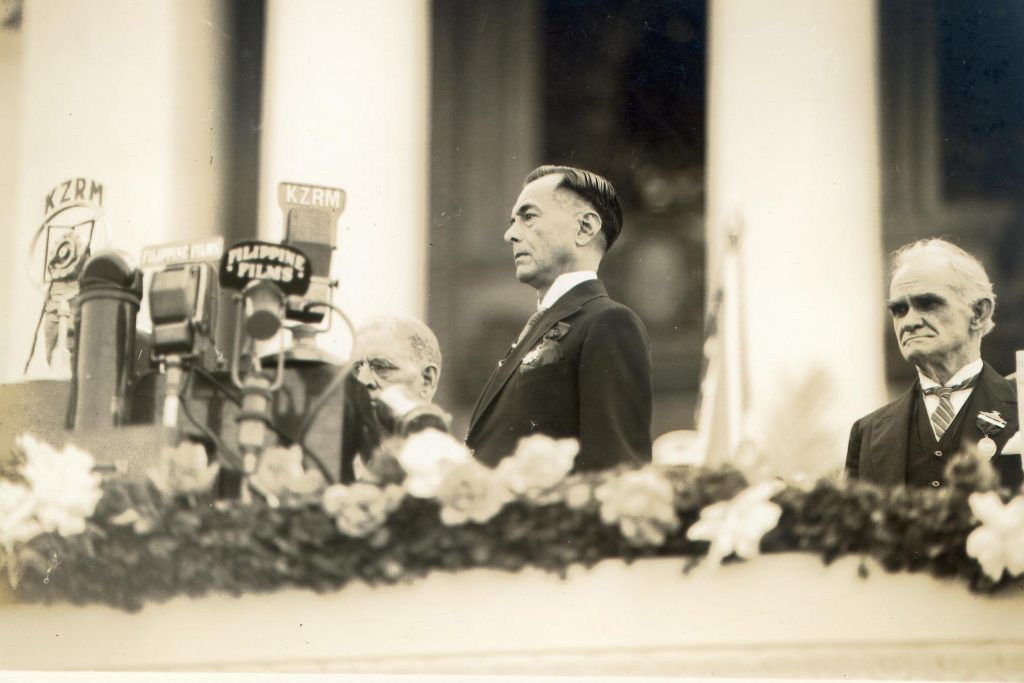
Manuel Quezon was the first president of the Commonwealth of the Philippines (1935-1944). For most of his career, he was a major political figure in the Philippines, fighting for the country’s autonomy and independence.
Quezon’s archived papers include correspondence, reports, speeches, articles, and other materials dating back to 1909, when he served as the first resident commissioner for the Philippines in the U.S. House of Representatives. These papers are so significant that, in 2011, they were inscribed in the UNESCO Memory of the World Register, which recognizes documentary heritage of global importance.
The original copies of the Quezon papers reside at the National Library of the Philippines. The Manuel Quezon microfilm was a joint project of the University of Michigan and the National Library of the Philippines to microfilm the papers.
Because of damage to the original Quezon papers, the Bentley’s microfilm turned out to be the most legible copy of these important documents.
To improve access to the Quezon papers, the Bentley Historical Library digitized its microfilm copy in 2023. The Bentley provided copies of the digitized papers to the National Library of the Philippines as well as to the National Historical Commission of the Philippines and the University of the Philippines Diliman library.
Now, the BHL has put these digitized papers online where anyone in the world can access them. The Bentley is grateful to its partners at U-M Library, who are hosting the online Quezon papers on their digital collections platform.
“The digitization of the microfilmed Quezon papers is an important step in making the study of Philippine history, particularly the American colonial and commonwealth periods of the country, more accessible to anyone,” says Ricky Punzalan, Associate Professor of Information, and a Filipino scholar. “The Bentley Historical Library is an institution with a large collection of Filipiniana archives. I am happy to see that it has made a crucial step to highlight its Philippine collections, build partnerships based on consultation with institutions in the Philippines, and collaborate with Filipino scholars at the University of Michigan. This makes this digitization project more impactful.”
On August 19, 2026, Punzalan will host an online symposium, sponsored by the Bentley Historical Library, about the digitized papers in collaboration with Filipino scholars. Registration is free and open to the public. Speakers include:
- Fe Angela M. Verzosa (Retired Librarian and Archivist, one of the librarians who processed the Quezon Papers at the National Library of the Philippines)
- Dr. Francis A. Gealogo (Professor, Ateneo de Manila University Department of History)
- Veronica Sison (Ph.D. student at UC Berkeley Department of South and Southeast Asian Studies)
U-M has thousands of artifacts from the Philippines spread throughout multiple campus locations—including the Bentley. Alexis Antracoli, Director of the Bentley Historical Library, says that this type of reparative work is critical not just for one project but in an ongoing, meaningful way for U-M writ large.
“Our decision to digitize the Quezon papers was based on in-person conversations between librarians at the National Library of the Philippines and Bentley archivists in 2024,” she says. “The project demonstrates that listening and relationship building are critical building blocks in ensuring that our reparative work is meaningful and impactful to source communities.”
Anyone is welcome to view the Quezon collection online, which is free and open to the public.
LEARN MORE:
How a visiting researcher from the Philippines identified important documents at the Library.