The Bentley Historical Library will be closed on Friday, July 3, 2026 and Saturday, July 4, 2026 in observance of Independence Day.


Magazine

The Art of Keeping Score

Archived scorecards at the Bentley tell the story of Michigan baseball over time, including the quirks of the game, how it’s changed, and how it’s remained remarkably the same.

By Nathan Schreck

On June 16, 1962, at Municipal Stadium in Omaha, Nebraska, the Michigan baseball team was playing for its second national championship. Inside the dugout, team scorekeeper Morris Moorawnick was keeping meticulous records of each pitch and play.

Writing a simple “F9” in the bottom corner and a “3” in the middle of a box, Moorawnick (see sidebar at the end of the story) inked the final out of the Wolverines’ baseball national championship in the scorebook. With the F9 signifying a flyout to the right fielder and the 3 representing the third out of the inning — and last of the game — the Wolverines 15-inning thriller capped off an improbable run to their second national championship.
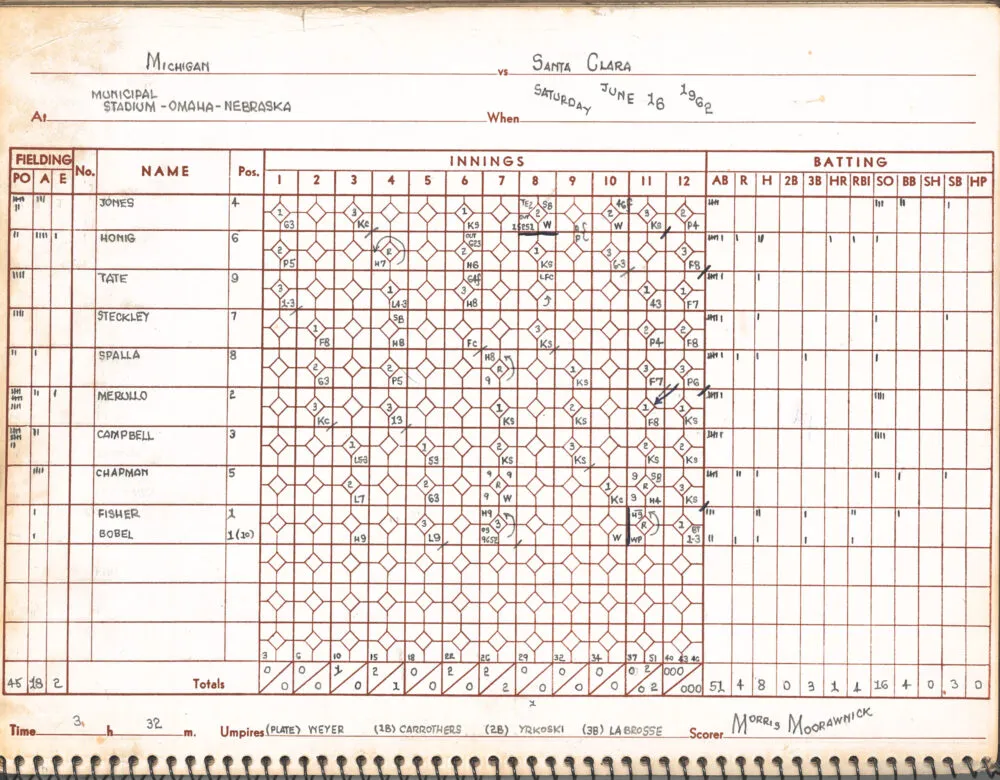
A page with grid patterns marked with pencil showing baseball scores from a 1962 University of Michigan game.

A 15-inning University of Michigan baseball game is documented in this baseball scorecard, archived at the Bentley Historical Library.

In an era before college baseball TV broadcasts, the play-by-play about this game is understood through one medium: the game’s scorecard housed at the Bentley Historical Library. Today, these scorecards tell the story of Michigan baseball over time, including the quirks of the game, how it’s changed, and how it’s remained remarkably the same.

A History of Scoring

Baseball has evolved in a myriad of ways throughout its history, but one aspect of the game that has stayed shockingly consistent is the concept of the scorecard.

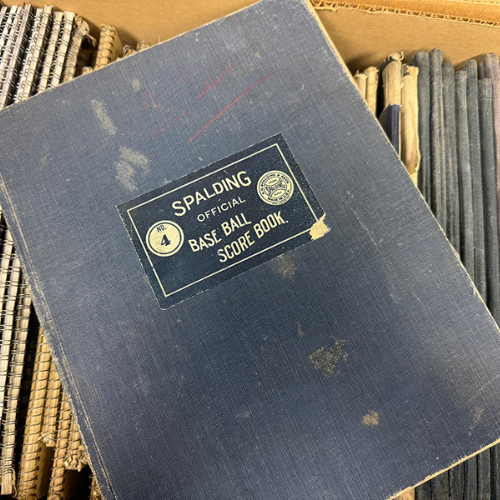
In 1859, Henry Chadwith conceived this new way to record statistics and plays in a baseball game. With a table-like format, including a box for each batter in each inning, Chadwith’s invention paved the way for a nearly universal language of understanding the game. Chadwick went on to help mass produce the Spalding Base Ball Guide, which helped spread the practice of scorekeeping across the country.

The Bentley Historical Library houses a collection of scorecards detailing the Michigan baseball team’s games and exhibitions. Thanks to a donation from Bruce Madej and the Athletic Department records, the Bentley archives contain 50 scorebooks from various seasons in the U-M baseball team’s history. These archival items serve as both records for one of the winningest college baseball programs of all time and also demonstrate how the practice of scoring and the game of baseball have evolved over the past century.

Anatomy of a Scorebook

While scorecards can contain what feels like an overwhelming amount of information, the layout is intuitive, conveying what happens in each inning. A grid-like pattern provides a space to chart what happened in every at-bat of a game. Each row represents a hitter and their at-bats and each column represents one inning. Additionally, spaces at the bottom of each respective row and column allow the scorer to tally runs, hits, errors, and runners left on base at the end of each inning and game.

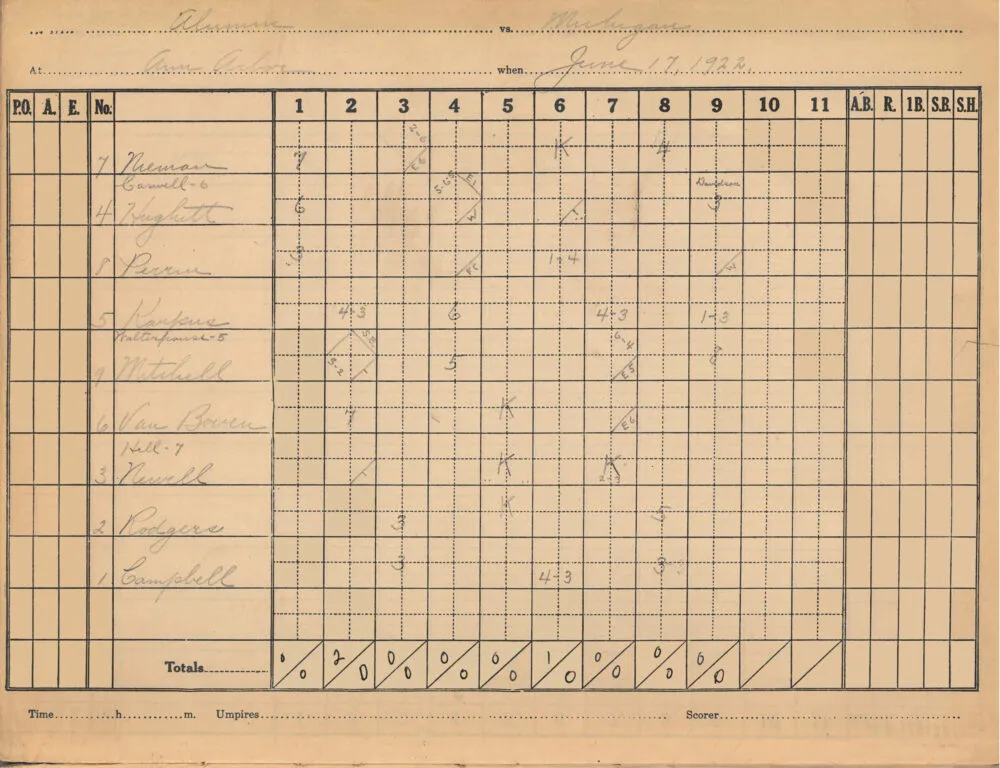
While there have been some changes in the layout of the scorecard over time, the vast majority of every scorecard will contain these details. However, one aesthetic difference between contemporary and older scorecards is how each box is laid out. For example, in the Wolverines’ scorecards from 1922-1949, each box is divided into four quadrants. This early design allowed scorers to note how a runner progressed to each base.

A aged piece of paper covered with a grid that has faint pencil marks on it, showing plays from the 1922 Michigan baseball season.

A 1922 baseball scorecard from game played against alumni in Ann Arbor.

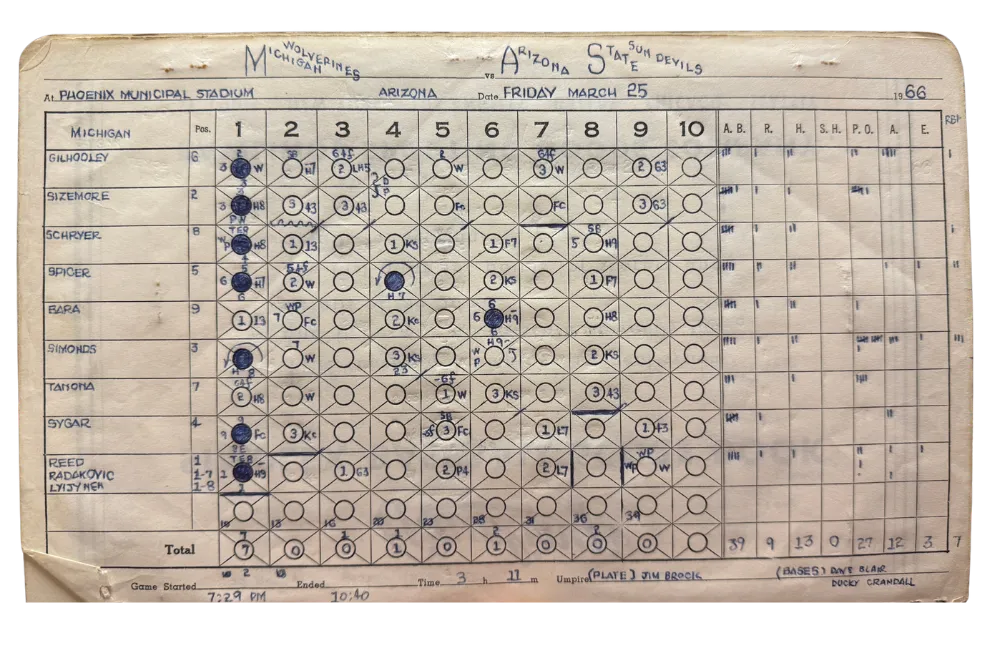
Later on, a more complex pattern became the norm in scoring. A circle in the middle of each box allowed the scorer to note if an out was created or, if filled in, that player made it to all four bases safely and scored a run. The rest of the box was divided into the standard quadrant-style notation reminiscent of a geometric mosaic.

A white page with columns and grids, with markings that show baseball plays.

A 1966 baseball scorecard from a game against the Arizona State Sundevils, played in Phoenix.

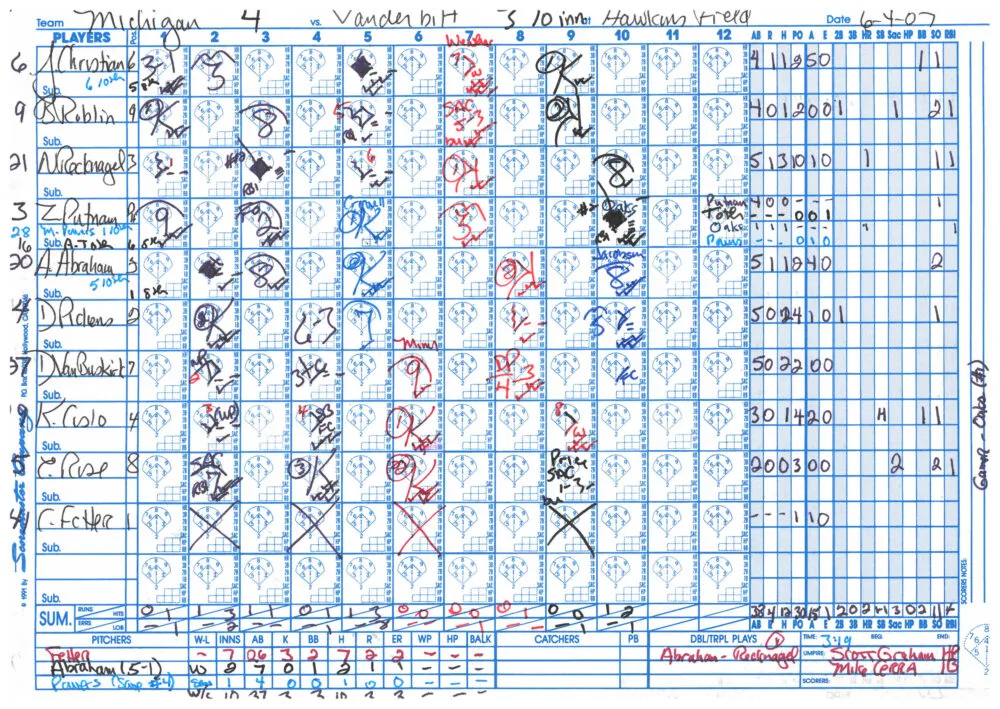
Contemporarily, many boxes contain a small baseball diamond, complete with base paths and an outfield. But while the format of each box has adapted through the years, the notation and shorthand is almost entirely the same. Across more than a century of scoring, the practice has stayed largely the same, yet adapted to a layout that the scorer prefers.

Grids and columns across a sheet of paper with red, blue, and black ink showing baseball scores from a 2007 Michigan baseball game.

A 2007 baseball scorecard from a University of Michigan vs. Vanderbilt game, played at Hawkins Field.

The scorecards’ features also show how the game of baseball has changed over the decades. In early scorecards, a box for errors is listed next to the player’s name along with put-outs and assists. Errors are defined as defensive misplays, for example a fielder dropping an easy fly ball. Inferior gloves, bumpier grounds, and less sophisticated scouting contributed to errors that were far more common in early baseball than they are now. Contemporary scorecards don’t feature boxes for errors as prominently, likely because the number has simply decreased.

Conversely, a box for the pitcher’s name became more standardized as the decades went on. This could be because early teams had far fewer pitchers than they do now so the need to note a pitcher (or pitchers) was less apparent. As the game evolves, the scorecard evolves with it.

Scorekeeping: An Artform

Scoring was often done by the student manager of the Michigan baseball team, and their scoring style can be seen beyond just their handwriting. Even though scorekeeping shorthand is largely universal, scorekeepers often added their own flair.

In scorebooks from 2007-2009, the scorekeeper liked to color-code batters by what pitcher they faced. The scorer also graphed ground balls, line drives, and fly balls with a corresponding type of dash.

In an earlier 19th-century example, the scorer used an “H” with one dash to convey a single, two dashes for a double, three dashes for a triple, and four dashes for a home run instead of the traditional 1B, 2B, 3B, HR notation. Since there is no “correct” way to score a game, a scorer can mark the sheet as they please. And even with small differences in shorthand, most readers versed in the art of scorekeeping can look at a sheet from more than a century ago and decipher exactly what happened in that game, almost like reading a piece of sheet music.

These scorebooks contain additional pieces of valuable information. For example, books from the 1920-40s tallied calculations of ERA, individual batting average, and team batting averages. This illustrates the importance of these statistics in particular to 20th-century baseball.

From Michigan to Japan

One of the most unique records kept in the Bentley’s archives are descriptions of Michigan’s games against Japanese collegiate baseball teams.

In the early 1900s, baseball was used as a diplomacy tool, and inter-continental matchups served as displays of cultural unity and goodwill between the United States and Japan. Fielding Yost, the athletic director at that time, was even gifted a set of samurai armor, which was later donated to the Bentley and is now kept at the U-M Research Museums Center.

Players from Keio University (Minato) first came to Ann Arbor in 1911, and several other Japanese universities visited U-M in the coming decades. In 1929, Meiji University (Tokyo) invited Hall of Fame Michigan coach Ray Fisher and his squad to travel to Japan for a series of exhibitions.

Accounts of the 1929 games describe Michigan’s hitting and pitching as being better than their Japanese opponents, while the Wolverines’ fielding and baserunning couldn’t keep pace with their hosts. The scorecards confirm this, also including notes on weather and attendance — integral details beyond the scope of just gameplay.

In addition to the Japanese games abroad, the scorecards also document details about unusual games against military forts, professional teams, and municipality teams such as Ypsilanti and Grosse Ile.

Open to the Public

The scorecard collection at the Bentley furthers researchers’ understanding of baseball and its place in physical culture studies. They provide key insights to early collegiate athletics — a topic that is not always well documented.

The more than 50 scorebooks from various seasons in the U-M baseball team’s history are open to the public at the Bentley Historical Library, and issues of The Michigan Daily, which also document U-M’s baseball history, can be accessed for free online.


The Scoring Style of Morris Moorawnick

One notable score keeper for the Wolverines during the 1950s and 1960s was Morris Moorawnick. Moorawnick was a prominent figure in Detroit athletics, working for the Detroit Pistons, Wayne State University, and hall of fame Michigan baseball coach Ray Fisher.

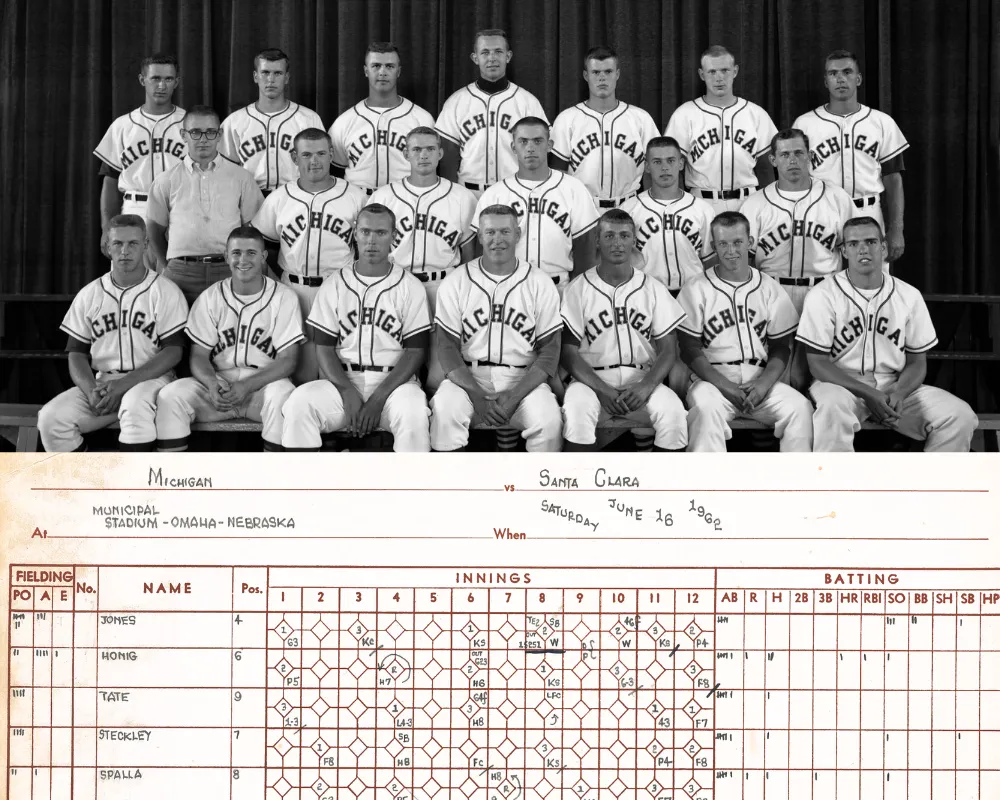
Moorawnick’s small, neat, and artistic way of scorekeeping demonstrates the artistry within the medium. As swirling, captivating fonts name the competing teams at the top of the sheet, a uniform-like font tells the story of the game’s events. Moorawnick’s unique style can be seen at the Bentley covering two different national championship baseball seasons including the scorecard of the 1953 national championship win over Santa Clara.

A black and white photo of baseball players in three rows, layered on top of a white piece of paper with grids and symbols depicting baseball scores.

The 1962 U-M baseball team photo, and Morris Moorawnick’s unique style of scorecard.