
By Andrew Rutledge
Every year, the thousands of students who graduate from U-M’s Horace H. Rackham School of Graduate Studies complete research projects ranging from complex lab work to groundbreaking field studies to painstaking examinations of archives—and countless more. It’s this work that helps make U-M one of the world’s leading research universities today. This year, the Rackham Graduate School celebrates its 150th anniversary.
But graduate education at Michigan—and in the United States more broadly—didn’t always look like this. Records preserved at the Bentley Historical Library reveal not only the evolution of graduate education at U-M, but also the stories of the men and women who earned their advanced degrees in Ann Arbor.
Today, a master’s degree and a doctoral degree represent different levels of academic achievement, but when they first emerged in the universities of medieval Europe they were broadly equivalent. The title magister (Latin for “master”) was given to university graduates when they began to teach, but the use of “master” or “doctor” in the degree name was generally a matter of custom at a university. By the early 1800s, however, the master’s had become a distinct degree, typically awarded to former students who demonstrated some sort of vaguely academic merit since their graduation. This was known as earning a degree “in course.”
Just as every other college and university in the United States in that period, it was this type of master’s degree that U-M first granted. In April 1845, the university’s Board of Regents voted that no candidate for a Master of Arts “shall receive this honor, unless he has preserved a good moral character, and…has signified his desire [for such a degree] to the Faculty.” Four years later, the Regents awarded the first two masters’ degrees to Merchant Goodrich (B.A. 1845) and Winfield Smith (B.A. 1846).
According to Bentley records, Goodrich was a member of the first U-M class in Ann Arbor after it had moved there from Detroit and went on to be the first U-M alum to attend Harvard Law School. Smith would go on to serve as Wisconsin’s Attorney General, but he never learned of the honor he’d received from his alma mater. As he lamented in 1889, he had “applied for [his master’s], wrote Latin essay, & sent on, but never heard anything from it, suppose the essay was not good enough.” Clearly it was more than good enough, but U-M’s non-existent alumni communications team was lacking in those days.
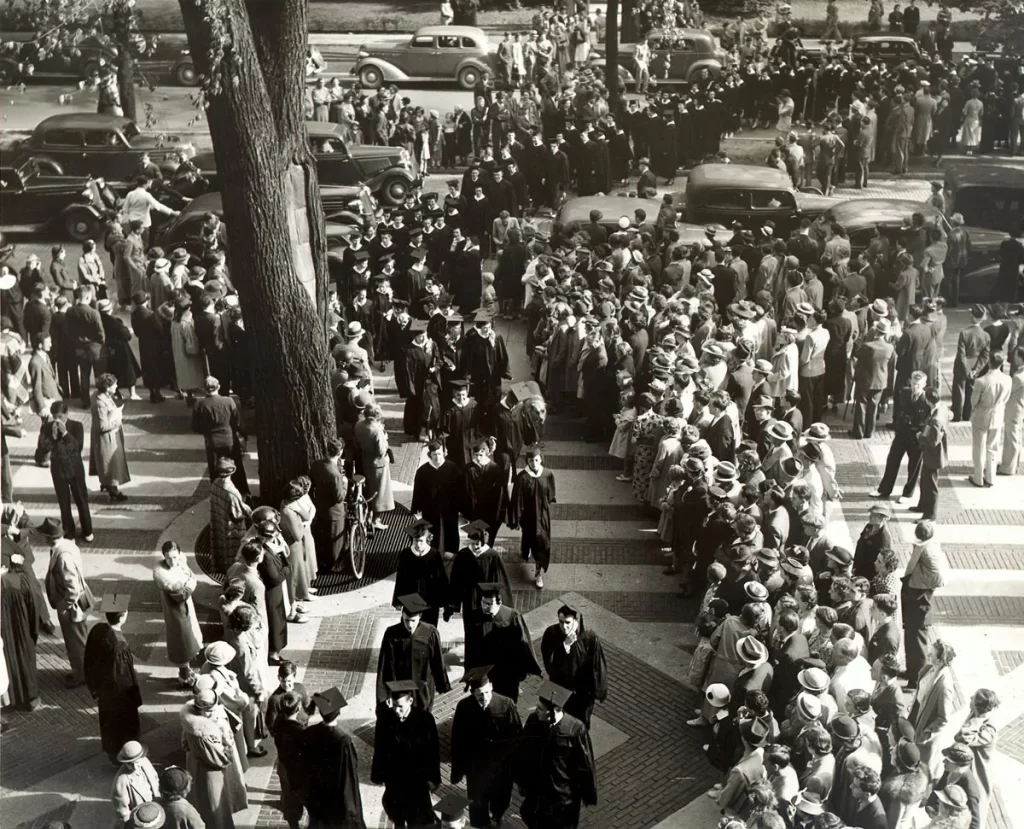
U-M students march in a 1937 graduation ceremony. Image source: Ivory Photo collection
When Henry Philip Tappan arrived as the university’s first president in 1852, he was determined to improve the quality of a U-M education. A firm believer in the benefits of the more research-focused university system in Germany, Tappan wanted to create a new system for graduate work. Under this new format, a committee of faculty would verbally test students who had taken at least four additional courses after completing their undergraduate degrees and who had also written a thesis based on original research. Only those who passed would receive a master’s degree. These types of degrees were known as “master’s upon examination.”
Tappan argued such a system would advance U-M “to the scope and dignity of a true University.” And, based on the first two students to earn their master’s degrees under this new format in 1859, he was right.
James Craig Watson was a mathematical prodigy who would go to become one of America’s most celebrated astronomers and director of Michigan’s Detroit Observatory. His astronomical records and details of his travels can be found in his collection at the Bentley. While his colleague De Volson Wood would become the first chair of U-M’s Department of Engineering, preparing it for its explosive growth by the end of the century.
Yet this new program did not prove very popular among graduate students. By 1871 only fifteen degrees had been granted on examination, more than twice that had been granted in course. But the feeling was growing ever stronger among the faculty that more importance should be given to graduate work. President James Angell, who succeeded Tappan, felt this particularly strongly, dismissing degrees in course as doing nothing more than showing the recipient “had existed three years after [their] graduation.” Determined that a graduate degree would mean something, he announced that master’s degrees would only be awarded by examination beginning in 1877.
Angell also created a program for granting a new degree: doctor of philosophy. Recipients would have to complete two years of coursework rather than the one year required for a master’s. Among the Registrar’s Records at the Bentley are the reports from the faculty committees from 1876 of the first two doctoral recipients, Victor Vaughan and William Smith, detailing their coursework and research in chemistry and zoology respectively. Vaughan was singled out for how his work “presents, in a field thoroughly trodden, a wholly new application of well-known chemical reactions” that opened new areas of research. An early proponent of the not-yet-accepted germ theory of disease, Vaughan would go on to become dean of the U-M Medical School in 1891, holding the position for three decades. Like many of his peers, however, Vaughan was also a committed eugenicist and proponent of forced sterilization, which cast a dark shadow over his other achievements.
A decade later, the first woman received her Ph.D. from Michigan. The report of June Rose Colby’s defense of her thesis: “Some Ethical Aspects of Later Elizabethan Tragedy, Preceded by a Discussion of Aristotle’s Definition of Tragedy” is also in the Registrar’s Records. Colby’s post-graduation life is revealed by her response to a survey sent out by the Alumnae Council in 1924 and available at the Bentley. She informed the Council that she had gone on to become a professor at Illinois State Normal University (now Illinois State University). By the turn of the century, 10 more women had earned their doctorates from U-M.
In 1892, the faculty of the Department of Literature, Science, and the Arts (now the College of LSA) decided that the growing number of graduate students required a more formal structure to administer their work, so they established a “Graduate Department.” But in reality, this was little more than an advisory committee, and one that soon ran into difficulties both in funding students and coordinating with other schools on campus, particularly the College of Engineering.
As a result of these difficulties, in 1901 the Regents were asked to create a separate graduate unit representing the entire university. But it took another decade for it to actually happen. In 1915 the Regents organized a graduate school backed by the resources of the entire University. That year there were 326 graduate students on campus, including 95 women.
Twenty years later the trustees of the Horace H. Rackham and Mary A. Rackham Fund awarded the university a substantial endowment for carrying on graduate study and research. In recognition of this generous gift, the Graduate School was renamed the Horace H. Rackham School of Graduate Studies.