


Expansion and Renovation, 1928-1997
The Wolverines drew 297,641 fans during Michigan Stadium's initial season, including 84,401 for the dedication game against Ohio State. Total attendance dropped slightly in 1928 and 1929 but the "big" games continued to fill the stadium. Crowds for Ohio State, Wisconsin, Illinois, Iowa, and Harvard averaged almost 70,000. The 1929 Ohio State game drew 85,088 spectators, a record that would stand until 1943. The impact of the Great Depression began to be felt in 1930 and in 1931 total attendance dropped below 200,000. Even in 1932, a national championship year, the largest home crowd was only 40,560. Another national championship team brought a slight increase in attendance in 1933, but hard times on and off the field reduced 1934's total home attendance to 122,526, an average of just under 25,000 per game.
A series of mediocre teams in the mid-1930s contributed to low crowds. Attendance began to climb in 1937 and reached 297,000 in 1939 as future Heisman Trophy winner Tom Harmon, Forest Evashevski and company restored Michigan's winning tradition. The onset of World War II, however, would interrupt the growth in attendance. Not until 1945 would total attendance top the 300,000 mark.
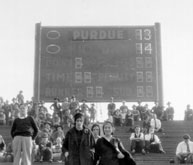
A New Scoreboard
In 1930, the University took advantage of new technology and installed electronic scoreboards at both ends of the stadium. In doing so, Michigan Stadium became the first to use electronic scoreboards. The scoreboards, estimated to cost $15,000, had been planned for in the stadium design, but the technology was not perfected until 1930. The new scoreboards were expected to make their debut at the Michigan State game. The game program described the operation of the boards and offered a caution.
"Both boards are designed to be operated simultaneously from a centrally located switchboard in the press box. Downs, yards to go, runner and other information is relayed to the switchboard by means of telephone, a terminal for which is located every ten yards along the west side-lines. A further check on runner, down, and yards is made by means of a 'signal cross' operated by a man who follows the teams up and down the field.
If the new boards do not operate quite perfectly today, we ask that you bear in mind its operators have never manipulated it before. Long before the second half, however, operating errors should have been corrected and the information show made accurate."
Alas, technical difficulties prevented use of the scoreboards at the Michigan State game. That may not have been too much of a calamity for the fans, however, since the game ended in a scoreless tie. By the following week the bugs were worked out and the scoreboards recorded a 14 to 13 Michigan win over Purdue. They would report many more Wolverine victories over the next 38 years before being replaced in 1968.
Yost Stadium or a War Memorial?
At its August 1945 meeting, the U-M Board of Regents received a petition presented by a group of Detroit alumni to rename Michigan Stadium as Yost Stadium in honor former coach and stadium builder Fielding H. Yost. The petitioners also submitted a file of supporting letters from alumni and students from across the country, including a number of former players, heads of alumni clubs and prominent graduates such as U.S. Supreme Court Justice Frank Murphy and New York Governor Thomas Dewey. Action on the petition was deferred until a later meeting.
The Regents took up the matter at their September meeting and voted to refer the proposal to the Board in Control of Intercollegiate Athletics (BICA). They added a proviso that if the Board in Control reported in favor of the proposal and if the university lawyer's found nothing to prevent a change, the regents would vote by mail on the proposal before their next meeting.
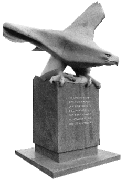
Yost himself discouraged the effort to rename the stadium in his honor. In a letter to the Detroit alumni, he instead suggested that a War Memorial be erected at the stadium honoring either all the university's men and women or the varsity athletes who had sacrificed their lives in World War II. The alumni petitioners adopted Yost's suggestion and withdrew their request to rename the stadium.
The BICA did not report back to the Regents until November. Its recommendation closely followed Yost's suggestion. A BICA committee including Athletic Director Crisler was appointed to consider "the nature of the proposed memorial, its location, its cost, the proper method of financing the memorial, whether it should be dedicated to all Michigan men and women or only to athletes, and the time and nature of suitable dedicatory exercises after the proposed memorial shall be completed."
Over the next six months the BICA committee considered a number of memorial proposals before narrowing its choices to two options. The first proposal was for a memorial inside the stadium, a stone inset in the brick wall near the flag pole. It would be a block of pink granite on which would be carved an eagle and a suitable inscription noting "that it was a memorial to Michigan men and women who lost their lives in the late war." (The decision had apparently been made that the memorial would honor all university men and women, not just athletes.)
The second option was a proposal from Birmingham, Michigan sculptor Marshall Fredericks. It called for a bronze sculpture on a granite base to be located on the lawn of the south slope of the stadium. The sculpture would depict an "eagle with a twelve foot wingspan depositing on the stone a wreath to the Michigan dead. " The stone would be carved with the University of Michigan seal and an appropriate inscription.
The cost of the stone memorial was estimated to be $6000 while the eagle sculpture was priced at $10,000.
At its June 3rd meeting the BICA adopted Frederick's proposal unanimously. It recommended that the dedication ceremony be set for the Michigan State game on November 6, 1946. The Board of Regents adopted the BICA recommendation at its June meeting.
BICA Stadium Dedication and War Memorial committee member John Tracy reported to the October BICA meeting the "it would be unwise to plan on dedication ceremonies" at the November 6 Michigan State game as the sculpture would not be completed "due to the inability to procure the necessary materials." The committee therefore recommended that the dedication be deferred "until such time as the sculpture is completed and appropriate dedicatory ceremonies can be arranged."
"Such time" turned out to be over four years. It was not until June 3, 1950 that the memorial was finally dedicated. Athletic Director Herbert Crisler unveiled the statue, presenting it to University President Alexander Ruthven as a gift from the Board in Control of Intercollegiate Athletics. Law School professor and BICA member John Tracy and Mrs. Fielding H. Yost also participated in the ceremonies.
The sculpture had changed somewhat from Fredericks' original proposal. The wingspan measured 24 feet and the university seal disappeared from the base. The simple inscription read "In memory of the men and women of the University of Michigan who gave their lives for their country." The Michigan Daily's coverage of the ceremony included Fredericks' comment on the two ideas he tried to convey in the design; "first, the monumental American eagle grasping in its talons the laurel wreath symbolizing the eternal protection of the honored memory of the war dead; and secondly, through powerful dynamic forms and outlines represent the strength, courage and vitality of the young men and women to whom the memorial is dedicated."
Marshall Fredericks went on to become one of Michigan's best known artists. He was an assistant to Carl Milles at Cranbrook and taught there for a number of years as well. He also also created the bas-reliefs Dream of the Young Girl and Dream of the Young Man that for years hung on the facade of the LS&A building and are now on the north wall of the Bentley Library. Fredericks is perhaps best known for his work The Spirit of Detroit.
Post-War Expansion
In the post-war years, the return of veterans to campus, economic prosperity and some very good teams once again brought capacity crowds to Michigan Stadium. A seven game home schedule made 1946 the first season with over 500,000 home attendance. The 1947 national championship team averaged 76,116 spectators over six games, including three sellouts at 85,938. Another national championship squad in 1948 drew an average of 81,611.
With sellout crowds again the norm, plans were drawn up to increase the size of the stadium in 1949. The most ambitious of the plans called for the addition of a top deck entirely around the stadium, increasing capacity to 125,300. A more modest plan was adopted to install permanent steel stands around the stadium concourse, where Yost's temporary bleachers still stood. The thirteen rows of additional seats increased stadium seating to 97,239. In its first game in the enlarged stadium, Michigan drew a then-record capacity crowd to the contest against Michigan State. In the first season of official NCAA attendance records (1949), the final tally showed Michigan leading the nation in average home attendance with 93,894.

Adolph "Germany" Schulz, All-American
center who played for Fielding Yost,
1904-1908, on Regents and Ferry
Field, inspects the welding on seat
brackets of 1949 expansion

The 1949 expansion replaced the old
wooden bleachers, bringing capacity
to over 97,000.

13 rows of steel bleachers were added in 1949
Breaking the 100,000 Barrier
Seven years would pass before the capacity of Michigan Stadium was raised again with the building of the Michigan Sports Communications Center (press box). Built at a cost of $700,000, the new structure provided a host of resources, including a press area, a photo deck, darkrooms and various other amenities. Dedicated on September 22, 1956, the press box and the additional seating constructed along with it raised the capacity of Michigan Stadium from 97,239 to 101,001. The 3,762 new seats came from a variety of sources:
- 542 seats in the new Communications Center
- 1,274 seats beneath the press box
- 156 seats by rearrangement of box seats, chairs were replaced with benches and an extra row was obtained
- 1,790 seats by realignment of seats in the corners of the bowl. Fritz Crisler's staff had discovered that many corner seats exceeded the standard 18 inches in width. So the widths were made uniform and a couple seats were gained in each row..
According to a newspaper article quoting an Athletic Department staff member, "Fritz wanted to end up with a figure of 100,001, but he came up with a thousand seats too many. But he still got that 001 at the end." This began a tradition of ending all Michigan Stadium capacity numbers with the digit 1. The final seat was later said to be reserved in honor of Fritz Crisler. On October 6, 1956 Michigan Stadium hosted over 100,000 people for the first time. The capacity crowd saw Michigan State defeat the Wolverines 9-0.
Though the Michigan football team suffered some lean years in the 1960s, the Wolverine faithful still journeyed to the corner of Main and Stadium in sizable numbers. Only the Michigan State games regularly broke the 100,000 mark, but between 1959 and 1971, Michigan averaged over 77,000 in home attendance and finished no lower than fifth in the nation in average attendance.
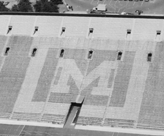
Dan Dworsky,
graduate of the
School of Architecture
and
member of national champion
teams in 1948 and 1949,
designed the Block M. He was
also the architect for Crisler Arena.
During this period, major changes and renovations to the stadium continued. In 1965, the wooden benches were covered in blue fiberglass to prevent weathering and discoloration of the seats. It was then that the yellow "Block M" was created on the east bleachers of the stadium, a design done by former U-M player Dan Dworsky. In August 1968, at a cost of $75,000, the scoreboards at the north and south end of the stadium were replaced after 38 years of service. The new scoreboards added the number of time outs left for each team as well as the spot the ball was on, in addition to the features given on the old boards. These scoreboards, measuring 41 feet by 16 feet, would remain in use through the 1997 season.
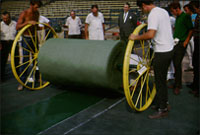
Installing Tartan Turf, 1969
Based on evidence that artificial turf could withstand any type of
weather and required less maintenance than grass, the Regents of the
University of Michigan approved the installation of artificial turf at
Michigan Stadium. In July 1969, a total of 88,285 feet of Tartan Turf was
installed at a cost of $250,000. In its first game on the new surface,
Michigan defeated Vanderbilt, 42-14. However, the Wolverines would drop
their next home contest, 40-17 to Missouri on October. 4, 1969. After this
defeat, Michigan would not lose at home again until November. 22, 1975 - a
span of 41 games.
In the summer of 1973, renovation plans called for the removal of many of the rails in the stadium and replacement of the box seats in the first three rows with bleacher seats. This change allowed for six hundred more seats in the stadium, and capacity was now 101,701. In 1974, Michigan led the nation in average attendance, as it has done every season since, with the exception of 1997 when Tennessee's expanded Neyland Stadium topped U-M for one season. Another game of note in the 1970s was Michigan's shutout of Purdue on November 8, 1975. That day, 102,415 fans witnessed the beginning of a still unbroken string of games in which the Wolverines have played before more than 100,000 fans.
Michigan resurfaced the field with artificial turf in 1975 and 1982. When the carpet needed replacement again in 1990, a decision was made to return to a natural surface in time for the 1991 season. Michigan played its last home game on artificial surface against Minnesota on November 17, 1990, winning, 35-18. The Wolverines' home record on artificial turf was an impressive 120-17-3 over 22 seasons.
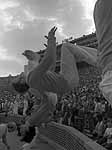
In May of 1991, 87,000 square feet of prescription athletic turf was installed as part of a comprehensive renovation of Michigan Stadium. While the playing surface was torn up the field was lowered by three and a half feet to facilitate sight-lines in the lower rows. This allowed for the addition of two rows to the lower seating area of the stadium, raising capacity to 102,501. The bill for these improvements came to $2,250,000. The renovations did have an additional cost. The cheerleaders would no longer be able to perform the traditional back flip off the wall.
As Michigan closed out the 1993 regular season against Ohio State, 106,867 fans filed into the stadium, breaking both the Michigan Stadium and NCAA single game attendance records. The number of people in Michigan Stadium that day exceeded the population of all but 185 cities in the United States and increased the Wolverine season tally to 739,560, another NCAA record. Those records would stand until 1997 when Michigan Stadium temporarily relinquished its title as the nation's largest college owned stadium.
Image Credits:
- 1930 Scoreboard - BHL, Alumni Assoc., Box 138, Football 1928-1932
- "Germany" Schulz inspecting stadium - BHL, Ath. Dept., Box 12, Michigan Stadium
- 1949 Expansion, Scoreboard - BHL, News and Info. Ser. A.
- 1949 Expansion, aerial view - BHL, Ath. Dept., Box 4 out., Michigan Stadium
- Block M on seats - BHL, Ath. Dept. Box 12, Michigan Stadium
- Installing Tartan Turf - BHL, Ath. Dept. Box 12, Michigan Stadium
top | previous | next
| Stadium Home Page | Ath. Dept. MGOBLUE |
Ath. History | Bentley Library