
The Bentley Historical Library can be an exceptional resource for faculty teaching classes at the University of Michigan.
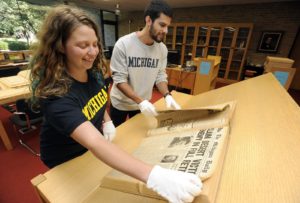
Students learn critical thinking, historical empathy, and more during engaging, hands-on sessions with archival materials!
We work with faculty to:
- Develop class sessions using Bentley’s rich collections.
- Design course-specific active-learning sessions to strengthen critical thinking skills using carefully curated selections of materials that can deepen students’ understandings of a subject, period, or document format.
- Guide students in how to search and discover materials within our holdings, using various databases and search strategies.
- Arrange an archivist’s presentation in your classroom (without original documents) on topics related to our collections, especially University of Michigan history.
To arrange a class visit:
Contact the Bentley Historical Library at: [email protected]. We ask that you contact us a month in advance, if possible.
Please include:
-
Your preferred visit date(s)
-
A syllabus or relevant assignment guidelines
-
The number of students in your class
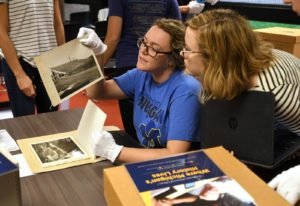
To prepare for your visit:
- Please have your class review our reading room rules.
- Remind students that the Bentley is not their usual classroom setting – consider sharing our statement developed with Services for Students with Disabilities office: This class will work with archivists and materials from the Bentley Historical Library. Working with the Bentley may be different from a typical class session or assignment. Most of the Bentley’s class sessions involve work with archival materials, or digital copies of materials. Examples include handwritten diaries, photographs, typewritten letters, videos, audio recordings, and archives websites. Many of these sources–even the text documents–have not been transcribed. If you think you might need an accommodation to access this material, please let your instructor know, or contact Meghan Courtney, Archivist for Academic Programs at [email protected]. The Bentley looks forward to welcoming you!
- For directions, bus and parking information, please see our visiting the Bentley page.
Examples of Classes
American Culture 103: Detroit and the Problem of Gentrification
Over two visits, 25-30 students learn about the Bentley, and in small groups, examine original materials created by the Detroit Urban League, which helps them critically analyze secondary sources about Detroit’s urban history. On their second visit, one of the Bentley’s field archivists joins the class for a conversation about our current collecting efforts in Detroit.
Education 118: Schooling in a Multicultural Society
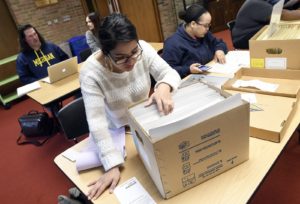
Up to 75 students visit the Bentley to examine local high school yearbooks from the 1910s through the 1950s.. Using a group activity, followed by guided discussion, the students identify how yearbooks reflect changes in schools over time, particularly in terms of demographics and educational priorities.
English 221: Literature and Writing Outside of the Classroom: Correspondence Course
After a brief introduction to the Bentley, students spend 1.5 hours examining letters from early University of Michigan students, from Michigan settlers, and from Michigan residents who served in the Civil War or World War II. Students choose a letter to respond to for their class assignment.
History 399: Topics in History: Environmental Activism at Michigan
Upper-level undergraduates participate in a semester-long research project using materials related to the University of Michigan’s first environmental teach-in, statewide grassroots environmental activist organizations, and the creation of protected areas in Michigan. The project culminates in a website featuring over 800 digitized primary source documents. Students visit the Bentley three times as a class, and return to the reading room in small groups for many hours of independent research.