
Magazine
And Then There Was One
Four houses, alike in symmetry, in fair Ann Arbor—all built in 1840. Only one stands today. Bentley collections reveal which one has endured, and what happened to the rest.
By Kim Clarke
In 1840, as the University of Michigan established itself in Ann Arbor, four homes rose on the young campus.
The buildings would serve as professors’ houses. Workers cleared the land—an area we know today as the Diag—of stumps and trees to make way for the houses. They dug two wells for fresh water and constructed woodsheds, barns, and cisterns.
The houses were initially built as square, two-story buildings with a center staircase.
The quartet of residences cost the young university a little more than $30,000 to construct.
Two houses sat on the south side of North University Avenue. They were mirrored by a pair of houses on the north edge of South University Avenue.
Records about who lived where amongst the four houses are spotty. The buildings sat empty for their first three years. The Board of Regents would often note when someone moved in or out, but rarely specified which house. We do know the earliest occupants included Patrick Kelly, a custodian who lived in the basement of one of the homes beginning in 1842. The university’s first two faculty hires—Joseph Whiting and George P. Williams—lived rent-free in the houses after being appointed. And Alpheus Felch resided on campus from 1843 to 1846 while a member of the Michigan Supreme Court.
In the 1870s, the university began using three of the houses for academic purposes. The houses’ various uses reflected the growing disciplines of the university in the mid- to late-19th century.
By 1921, three of the houses had been demolished. The lone survivor still stands at 815 South University Avenue—the President’s House, the oldest building on campus.
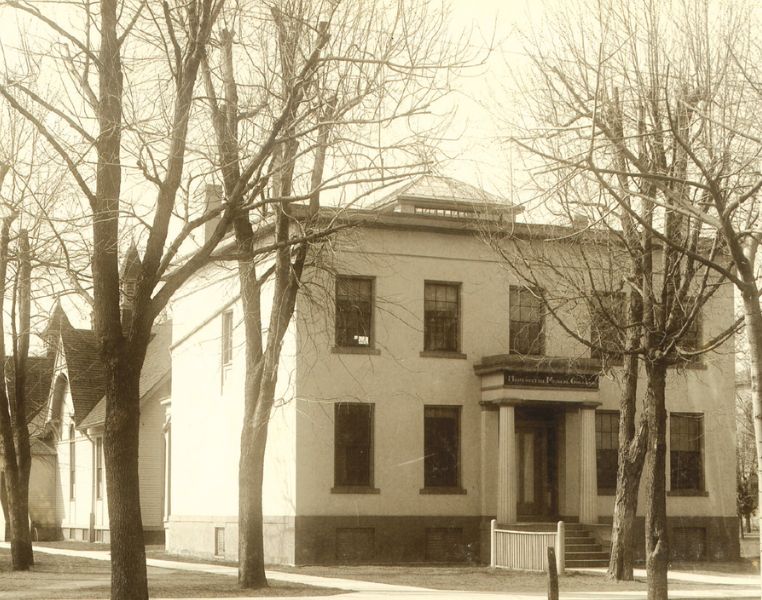
Northeast Professors’ House.
Northeast House
- A lightning rod was installed upon the house and its three neighbors in 1843.
- After being used as a private residence, the house was converted into University Hospital in 1869.
- As a hospital—the first in the country to be owned by a university—the building grew to have wooden pavilions, an amphitheater, kitchen space, and other additions.
- The hospital staff moved to a larger building in 1891. Dr. Fleming Carrow reminisced that the original hospital building “served for many years a most useful and beneficent purpose in aiding in the education of physicians and in properly caring for the sick.”
- The building became the Dental College in 1891.
- The Dental School building was torn down in 1908 to make way for a new chemistry laboratory. A year earlier, reporters at The Michigan Daily called the structure a “campus eyesore” and praised its pending demolition.
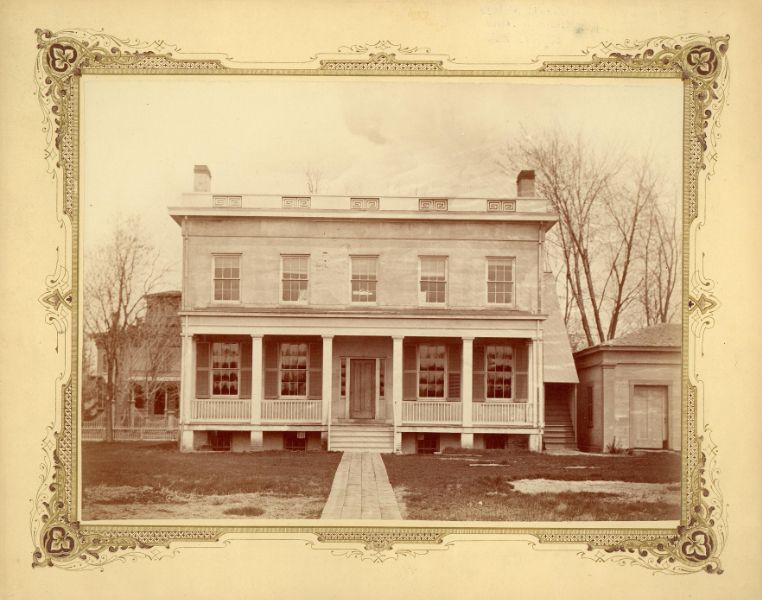
Northwest Professors’ House.
Northwest House
- After no longer being used as a professor’s residence, the house became the first home of the Dental School when it was established in 1875.
- The Homeopathic Medical College established itself in the structure—with an addition— starting in 1879.
- The Department of Pathology moved into the old house in 1899.
- The final tenant was the Department of Psychology, which called the building home starting in 1903.
- “The antiquated eyesore in which the psychology department is housed will probably be razed before it falls to pieces from sheer old age,” The Michigan Daily predicted in 1913.
- After nearly 40 years as a locus for health care, the building was razed in 1914. A new four-story Natural Science Building, with a 500-seat auditorium, was constructed on the site. Today, it is the School of Kinesiology.
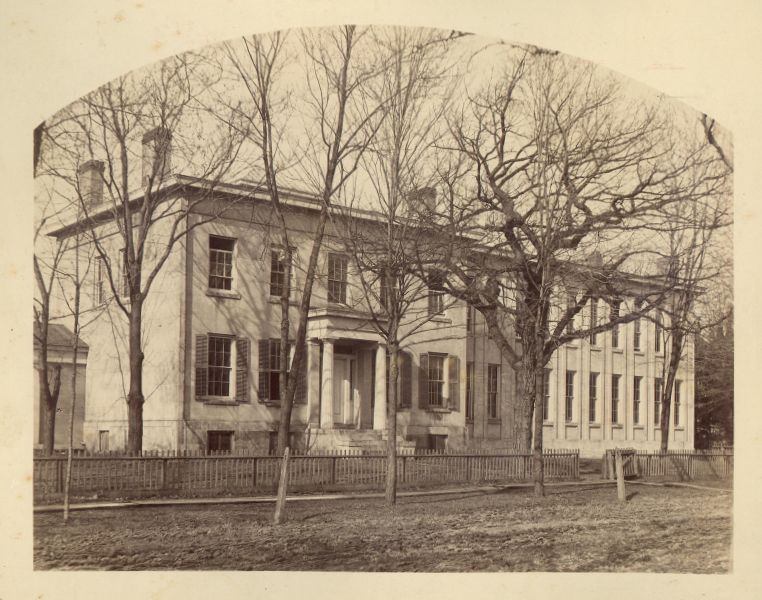
Southeast Professors’ House.
Southeast House
- Henry Simmons Frieze, a professor of Latin language and literature who served three times as interim president, lived here until 1877.
- It was enlarged in 1877 for the Dental School, which occupied the building until 1891.
- A brick addition and third story were added in 1891, when the College of Engineering moved in for what would become a 30-year residency.
- Engineers welcomed their new facilities. “The transfer to the new building will be hailed with joy by professors and students alike, for none can fail to appreciate the great advantage of this over the old ‘catch as catch can’ arrangement that has more or less handicapped engineering work in the University for some time past,” a student wrote in The Michigan Technic.
- The Old Engineering Building was torn down in 1921 to make way for the construction of the William L. Clements Library.
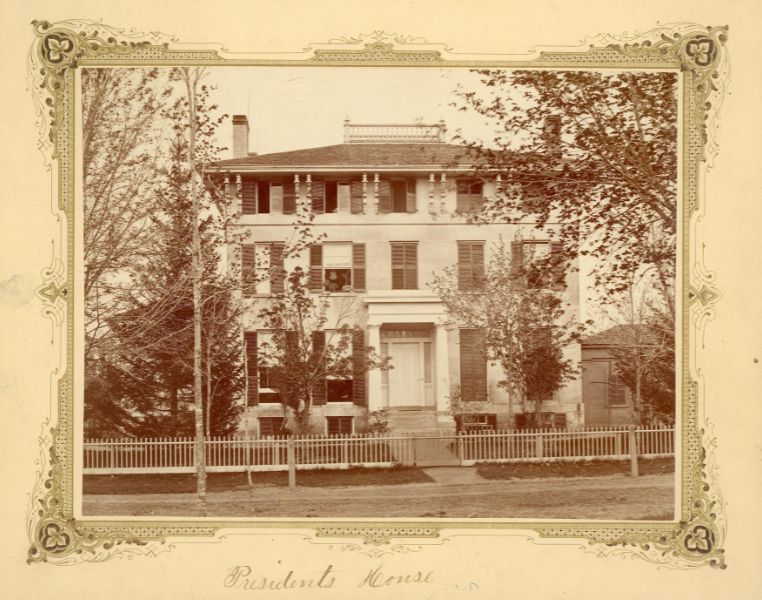
Southwest Professors’ House.
Southwest House
- First occupied by President Henry P. Tappan and his wife, Julia, in 1852.
- It was the first home in Ann Arbor to have indoor plumbing— a requirement of Sarah Angell before her husband, James B. Angell, accepted the presidency in 1871.
- Over the years, a third story and wings were added.
- President Harry B. Hutchins elected to remain in his Ann Arbor home rather than the residence. Angell continued to live in the house until he died in 1916.
- The house was the local headquarters of the American Red Cross during World War I.
- The size of the home awed Sally Fleming, whose husband, Robben, led U-M from 1968 to 1978. “We thought we needed roller skates to get from one end to another.”
- Current occupants are President Domenico Grasso and his wife, Susan.