
Magazine
The Shootout and the Fallout
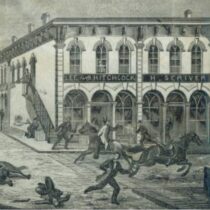
Two U-M medical students were present when Jesse James and other outlaws attempted to rob a bank in Minnesota in 1876. A letter preserved at the Bentley alleges that after two of the outlaws were killed, their bodies ended up in Ann Arbor for medical study.
By Lara Zielin
The shootout was over. Two bank robbers were dead on the street. It was September 7, 1876, and the outlaw Jesse James, along with his brother and members of the Cole Younger gang, had attempted to rob the First National Bank in Northfield, Minnesota. Brave local citizens had intervened and stopped the theft.
One of the local heroes was Henry Mason Wheeler, a medical student at the University of Michigan. Northfield was his hometown, and he was at the tail end of his summer vacation. He was sitting in front of his father’s drug store when the would-be robbers rode into town. When the robbers started killing innocent citizens, Wheeler grabbed a gun and started firing back. Wheeler killed gang member Clell Miller; another Northfield citizen killed bandit Bill Caldwell (known as Stiles). Wheeler then mounted a horse and joined the local posse that was forming to hunt down the six remaining outlaws. But before riding away, Wheeler found his friend Clarence Edward Persons, also a U-M medical student.
“This is our last year in school, Clarence, and we will need those two fellows for laboratory work,” Miller allegedly told Persons, according to a letter archived at the Bentley.
In other words, Wheeler wanted the bandits’ bodies for dissection back at U-M. In the 1800s, doctors in training needed cadavers to understand anatomy. But bodies were in short supply, since prevailing Christian beliefs reinforced needing a physical body for the coming resurrection. The high demand for medical school cadavers had Persons agreeing to make “arrangements,” according to the archived letter, which was dictated by Persons to his son in 1937.
Persons dug up the bodies of Miller and Caldwell and had them shipped back to U-M in barrels labeled “paint.”
The bodies arrived at U-M, but before the fall term was too far along, Caldwell’s relatives came to Ann Arbor demanding his remains.
Miller’s cadaver went unclaimed, and when Persons and Wheeler received their diplomas in 1877, Wheeler allegedly asked Persons, “What shall we do with this nice skeleton here, which you brought down from Northfield?” Persons replied, “Well, Henry, you shot him—I guess he’s yours.”
Persons’ letter alleges that Wheeler took the skeleton with him when he relocated to Grand Forks, North Dakota, where he practiced medicine until his death in April 1930. According to Persons, the skeleton remained in Wheeler’s office until it was destroyed in a fire.
The single letter from Persons is a small fragment in the long, and sometimes dark, history of anatomical study at U-M.
To learn more, please see the U-M Anatomical Donations Program collection, or read historian James Tobin’s piece Such Horrible Business (heritage.umich.edu, 2013). The archived Michigan Quarterly Review also has a longer piece on Persons, Wheeler, and grave robbing from the spring 1967 issue (volume VI, no. 2).